Why treehouses get refused or cited
Treehouses run into trouble when they break zoning rather than carpentry rules: too tall for the local height limit, inside a front or side setback, larger than the accessory structure exemption, supported by posts that make them a playhouse, or fitted with electricity or water. In a critical area such as a stream buffer, the permit exemptions may not apply at all.
Updated
Rather not do this yourself? We prepare your treehouse permit file for your address, and revise it until approved.
Get my permit · $399Key facts
- Winnetka, Illinois, sets two limits: a treehouse with a roof or walls may reach 15 feet from adjacent grade to its highest point, while an open platform with safety railings may reach 35 feet.[1]Village of Winnetka, Illinois, Playhouses and Treehouses
- In Winnetka, treehouses are not allowed in a required front or side yard setback, though they are allowed in the rear yard.[1]Village of Winnetka, Illinois, Playhouses and Treehouses
- The International Residential Code list, as published by Federal Way, Washington, exempts one-story detached accessory structures up to 200 square feet.[2]City of Federal Way, Washington, Residential permit exemptions
- Morgan Hill, California, sets 120 square feet for sheds, playhouses and similar uses.[3]City of Morgan Hill, California, When is a Permit Required
- In New York City, legalizing work done without a permit on a one- or two-family home carries a $600 civil penalty, and removing the work instead carries the same penalty.[5]New York City Department of Buildings, Form L2 instructions, civil penalties for work…
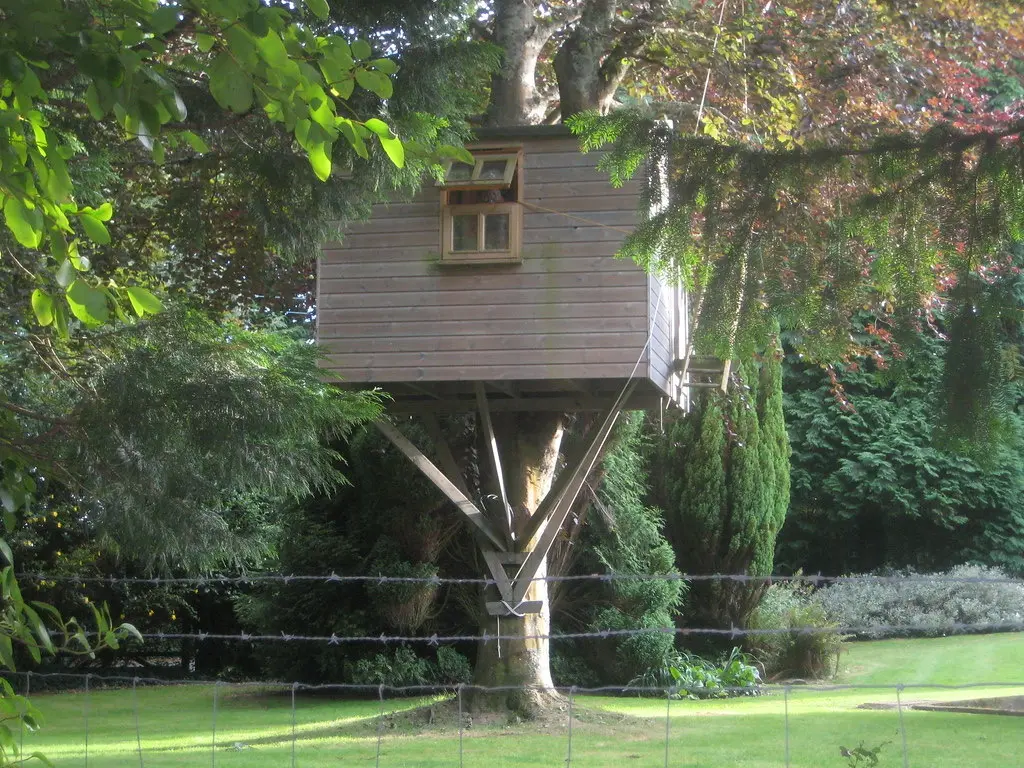
Why do treehouses get refused or cited?
A treehouse that is well built can still be refused, or cited after it is finished. The reasons named in published city rules are not about the lumber. They are about how tall it is, where it sits, how big it is and what the city decides it is.
| Reason | The rule behind it | Source |
|---|---|---|
| Too tall | Winnetka: 15 ft for a roofed or walled treehouse, 35 ft for an open platform, from adjacent grade | [1] |
| In the side or front yard | Winnetka: not allowed in a required front or side yard setback | [1] |
| Too big for the exemption | 200 sq ft under the IRC list; 120 sq ft in Morgan Hill, California | [2][3] |
| Wired or plumbed | Winnetka: no water or electricity in a treehouse | [1] |
| Posts in the ground | Winnetka: a ground-supported, enclosed play structure is a playhouse and needs a permit | [1] |
| Not for play | Prince William County: the treehouse exemption covers a structure for children to play in, not intended for occupancy | [4] |
| In a critical area | Federal Way: work in wetlands, streams, landslide areas and their buffers is not exempt | [2] |
1. The height limit
Height is the obvious risk, because the whole point of a treehouse is to be up high. Winnetka, Illinois, sets two limits: a treehouse with a roof or walls may reach 15 feet from adjacent grade to its highest point, while an open platform with safety railings may reach 35 feet[1]. Adding a roof to a platform can drop the allowed height by 20 feet. Measure from the lowest adjacent ground, not from the base of the trunk on the uphill side.
2. The wrong part of the yard
A big tree near the lot line stands exactly where the setbacks are. In Winnetka, treehouses are not allowed in a required front or side yard setback, though they are allowed in the rear yard[1]. A treehouse in the side yard is out of compliance no matter how small it is, and moving it means moving the tree.
3. Bigger than the exemption
When a city reads a treehouse as an accessory structure, the size exemption decides whether a permit is needed. The International Residential Code list, as published by Federal Way, Washington, exempts one-story detached accessory structures up to 200 square feet[2]. Morgan Hill, California, sets 120 square feet for sheds, playhouses and similar uses[3]. A platform with a wraparound deck adds area quickly.
4. The definition changes
Cities exempt a particular kind of structure, and a design can drift out of it:
- Posts. Winnetka exempts treehouses supported solely and entirely by trees. A play structure supported fully or partially by the ground and enclosed by walls and a roof is a playhouse, which needs a building permit and has a 7-foot height limit[1].
- Use. Prince William County's interpretation covers a structure built in the branches of a tree for children to play in, not intended for occupancy[4]. A treehouse fitted out as a guest room or an office is a different structure.
- Utilities. Winnetka does not allow water or electricity in a treehouse, because treehouses there are not subject to building code compliance[1].
5. A critical area under the tree
If your tree stands near a creek or a wetland, check this first. Federal Way states that any work in a critical area, including wetlands, streams, landslide hazard areas and their buffers, is not exempt from permits[2]. In such a place, even a structure on the exempt list needs review.
What happens after a complaint
A treehouse is high and visible from neighboring lots: it is the kind of project neighbors notice.
Legalizing work after the fact has a cost. In New York City, legalizing work done without a permit on a one- or two-family home carries a $600 civil penalty, and removing the work instead carries the same penalty[5]. And the issue can come back when the house changes hands: Fairfax County, Virginia, applies its unpermitted construction rules to properties bought and sold, regardless of when the construction was done[6].
How to avoid it
- Ask how your city classifies your design before you build: treehouse, playground equipment, playhouse or accessory structure.
- Draw the treehouse on your plat of survey, with its height from the lowest adjacent grade and its distance to each property line.
- Keep it out of the side and front yards unless your code says otherwise.
- Leave out water and electricity, or get the permits that come with them.
- Ask for a written answer. Winnetka encourages a zoning certificate even when no building permit is needed[1]; a written approval is worth more than a phone call when a neighbor complains.
That is what we prepare. The All-in, until approved offer ($399) includes the rule for your address with links, a site plan with the distances and heights your city checks, drawings and forms when a permit is required, a review before you file and our follow-up until the city approves. If the city refuses it for a written requirement we should have caught, the guarantee applies.
Common questions
Can the city make me take down a treehouse?
Yes, if it was built without a required permit or breaks the zoning rules, the city can require it to be brought into compliance or removed. In New York City, removing work done without a permit on a one- or two-family home carries the same $600 civil penalty as legalizing it.
Why would a treehouse need a permit if it is just for kids?
Because the exemption depends on the definition. Prince William County, Virginia, exempts a structure built in the branches of a tree for children to play in, not intended for occupancy. Winnetka, Illinois, exempts a treehouse supported only by trees, but a ground-supported enclosed playhouse needs a permit.
Do treehouses have to follow setbacks?
Yes, in many places. In Winnetka, Illinois, treehouses are not allowed in a required front or side yard, even though no building permit is needed.
We handle the permit. You build your treehouse.
- Your city's rule, for your addressThe code section, its link and the date we checked it.
- Site plan and dimensioned drawingsDistances to your property lines, ready for the application.
- The form, where to file it, and the published feePlus the documents list and an HOA request template.
- Reviewed, then revised until approvedWith All-in, after every comment from the city, for up to 6 months.
Sources
- Village of Winnetka, Illinois, Playhouses and Treehouses. Checked October 13, 2026.
- City of Federal Way, Washington, Residential permit exemptions (International Residential Code, Section R105.2). Checked October 13, 2026.
- City of Morgan Hill, California, When is a Permit Required. Checked October 13, 2026.
- Prince William County, Virginia, Building Official Interpretation 2021-01 (treehouse, pergola, fire pit, outdoor fireplace, gazebo). Checked October 13, 2026.
- New York City Department of Buildings, Form L2 instructions, civil penalties for work without a permit (rev. 03/2026). Checked October 13, 2026.
- Fairfax County, Virginia, Department of Code Compliance, Unpermitted Construction (September 2024). Checked October 13, 2026.