Treehouse permits, explained
Many cities do not require a building permit for a small treehouse built for children with no electricity or water, but zoning still limits its height and where it sits on the lot. A treehouse that is large, enclosed, wired, built on posts or used for sleeping is treated as an accessory structure and can need a permit like a shed.
Updated
Rather not do this yourself? We prepare your treehouse permit file for your address, and revise it until approved.
Get my permit · $399Key facts
- Winnetka, Illinois, goes further in writing: tree houses supported solely and entirely by one or more trees are not subject to building codes and do not require a building permit.[2]Village of Winnetka, Illinois, Playhouses and Treehouses
- The village still encourages a zoning certificate before construction starts.[2]Village of Winnetka, Illinois, Playhouses and Treehouses
- Federal Way also notes that any work in a critical area, such as wetlands, streams, landslide hazard areas and their buffers, is not exempt, and plenty of big old trees stand near a creek.[1]City of Federal Way, Washington, Residential permit exemptions
- Morgan Hill, California, exempts one-story detached accessory structures used as tool and storage sheds, playhouses and similar uses only up to 120 square feet, and sends you to its Planning Division for setbacks and height.[4]City of Morgan Hill, California, When is a Permit Required
- Fairfax County applies its unpermitted construction rules to properties bought and sold, regardless of when the construction was done.[6]Fairfax County, Virginia, Department of Code Compliance, Unpermitted Construction
Do you need a permit for a treehouse?
The building code does not have a "treehouse" chapter, so each city fits it into a box it already has. Which box decides everything:
| How the city sees it | What usually follows | Example |
|---|---|---|
| A child's treehouse, not for occupancy | No building permit, zoning limits still apply | Prince William County, Virginia[3]; Winnetka, Illinois[2] |
| Playground equipment | Exempt from a building permit under the IRC list | IRC R105.2, as published by Federal Way, Washington[1] |
| A playhouse or small accessory structure | Exempt below a size limit, permit above it | 200 sq ft under the IRC[1]; 120 sq ft in Morgan Hill, California[4] |
Start from the most generous answer and work down. Prince William County's building official answered the question directly in a written interpretation of the Virginia Residential Code: a construction permit is not required for a treehouse, defined as a structure built in the branches of a tree for children to play in, not intended for occupancy[3]. Winnetka, Illinois, goes further in writing: tree houses supported solely and entirely by one or more trees are not subject to building codes and do not require a building permit[2].
Then read the conditions. Winnetka's exemption comes with three of them: no water or electricity, a height limit, and no treehouse in a required front or side yard. The village still encourages a zoning certificate before construction starts[2].
The IRC exemptions that can cover a treehouse
In cities that use the International Residential Code (IRC), Section R105.2 lists the work that needs no building permit. Three items on the list are relevant to a treehouse, as published by Federal Way, Washington[1]:
- one-story detached accessory structures, provided the floor area does not exceed 200 square feet;
- swings and other playground equipment;
- decks not exceeding 200 square feet, no more than 30 inches above grade at any point, not attached to a dwelling, and not serving the required exit door.
That third item is the trap. A treehouse platform is usually far more than 30 inches above grade, so if your city reads it as a deck rather than as playground equipment, the deck exemption does not cover it. Federal Way also notes that any work in a critical area, such as wetlands, streams, landslide hazard areas and their buffers, is not exempt[1], and plenty of big old trees stand near a creek.
Local thresholds are often lower than the model code. Morgan Hill, California, exempts one-story detached accessory structures used as tool and storage sheds, playhouses and similar uses only up to 120 square feet, and sends you to its Planning Division for setbacks and height[4]. Fairfax County, Virginia, lists adding detached structures exceeding 256 square feet among the common projects that need a permit[6].
Treehouse or playhouse?
Winnetka draws the line that many families miss[2]:
- a tree house is supported solely and entirely by trees: no building permit;
- a playhouse is a play structure for children fully or partially supported by the ground and enclosed by walls and a roof: building permit required, a 7-foot height limit, and it counts toward floor area and lot coverage.
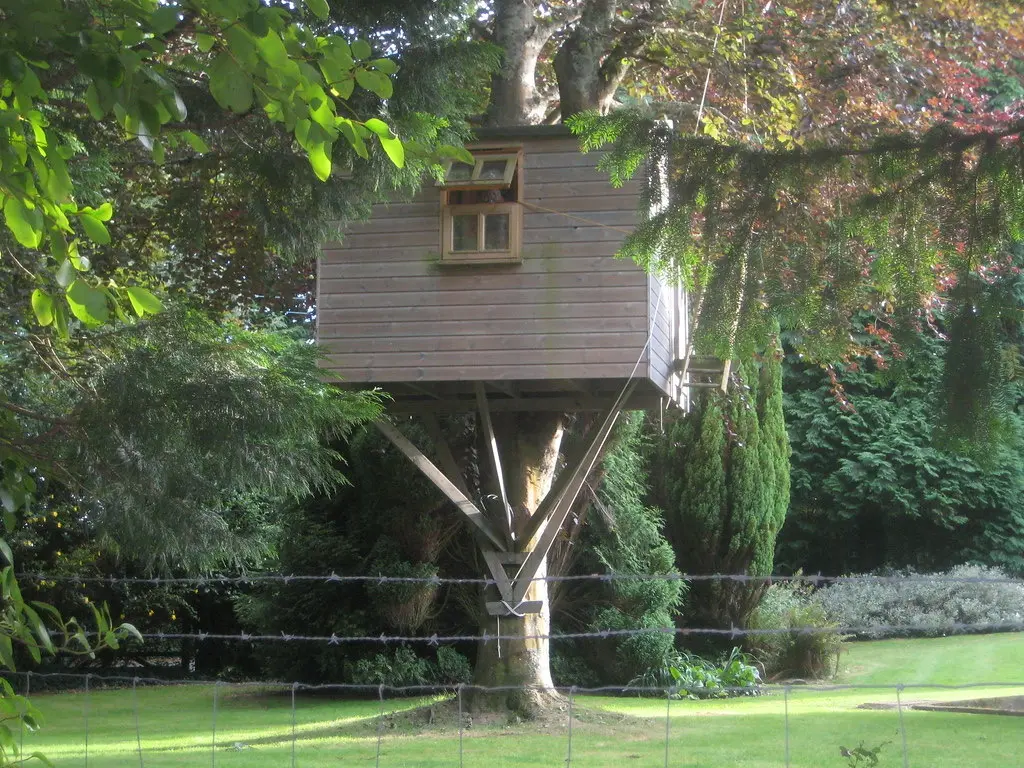
The photo at the top of this page shows a common design: a cabin resting on a trunk and on angled posts set in the ground. Under Winnetka's definitions, posts in the ground move a structure toward the playhouse side of the line[2]. If your design uses posts, ask your city which category it falls in before you build, not after.
Height and setbacks: zoning still applies
No permit does not mean no rules. Winnetka's zoning standards for treehouses are a clear example[2]:
| Rule | Winnetka, Illinois |
|---|---|
| Treehouse with a roof and/or walls | Up to 15 feet from adjacent grade to the highest point |
| Open platform with safety railings | Up to 35 feet from adjacent grade |
| Front and side yard setbacks | Not allowed |
| Rear yard setback | Allowed |
| Water or electricity | Not permitted |
Measure height the way the city does: Winnetka measures from adjacent grade to the highest point of the structure, typically the top of the roof[2]. On a sloping yard, the downhill side counts.
When a treehouse clearly needs a permit
The exemptions above stop applying, in at least one of the cities quoted, when:
- the treehouse has water or electricity (Winnetka does not allow either in an unpermitted treehouse)[2];
- it is supported by the ground, fully or partly, and enclosed, which makes it a playhouse in Winnetka[2];
- it is bigger than the local accessory structure limit, such as 120 square feet in Morgan Hill[4] or 200 square feet under the IRC[1];
- it is built in a critical area such as a stream buffer in Federal Way[1];
- it is intended for occupancy rather than children's play, which takes it outside Prince William County's definition[3].
What a treehouse permit application looks like
Where a permit is required, the file is close to a shed or deck permit: a site plan showing the treehouse on the lot with its distances to the property lines, a framing plan, an elevation showing the height, and the platform guards. If the treehouse is for children, the U.S. Consumer Product Safety Commission's home playground handbook is the reference to design to: guardrails or barriers around any platform more than 30 inches above the surface below, and openings either smaller than 3½ inches or larger than 9 inches so a child's head cannot be trapped[5].
Building without a permit
A treehouse is hard to hide: it sits high, in plain view of the street and the neighbors. And the structure outlives the childhood it was built for. Fairfax County applies its unpermitted construction rules to properties bought and sold, regardless of when the construction was done[6].
Get the answer for your address
For one city the answer is "no permit, stay out of the side yard". For the next it is "playhouse permit, 7 feet maximum". The All-in, until approved offer ($399) gives you the rule that applies to your address with the links, and, when a permit is needed, the site plan, drawings, forms, a review before you file and our follow-up until the city approves it.
Common questions
Does a treehouse need a permit?
It depends on the city and the design. Winnetka, Illinois, and Prince William County, Virginia, do not require a building permit for a treehouse used by children, but Winnetka still caps its height and keeps it out of front and side setbacks. Larger, enclosed or wired treehouses are treated as accessory structures in many places.
How tall can a treehouse be?
There is no national limit; zoning sets it. In Winnetka, Illinois, a treehouse with a roof or walls may be up to 15 feet from adjacent grade to its highest point, and an open platform with railings up to 35 feet.
Can a treehouse have electricity?
Not in every city without a permit. Winnetka, Illinois, does not allow water or electricity in a treehouse because treehouses there are not subject to building code compliance. Adding wiring generally brings an electrical permit and inspection.
Is a treehouse a playhouse under the building code?
Not always. Winnetka, Illinois, defines a treehouse as supported solely and entirely by one or more trees, and a playhouse as supported fully or partially by the ground; the playhouse needs a building permit, the treehouse does not. A treehouse on posts can fall on the playhouse side.
We handle the permit. You build your treehouse.
- Your city's rule, for your addressThe code section, its link and the date we checked it.
- Site plan and dimensioned drawingsDistances to your property lines, ready for the application.
- The form, where to file it, and the published feePlus the documents list and an HOA request template.
- Reviewed, then revised until approvedWith All-in, after every comment from the city, for up to 6 months.
Sources
- City of Federal Way, Washington, Residential permit exemptions (International Residential Code, Section R105.2). Checked October 13, 2026.
- Village of Winnetka, Illinois, Playhouses and Treehouses. Checked October 13, 2026.
- Prince William County, Virginia, Building Official Interpretation 2021-01 (treehouse, pergola, fire pit, outdoor fireplace, gazebo). Checked October 13, 2026.
- City of Morgan Hill, California, When is a Permit Required. Checked October 13, 2026.
- U.S. Consumer Product Safety Commission, Outdoor Home Playground Safety Handbook (Publication 324). Checked October 13, 2026.
- Fairfax County, Virginia, Department of Code Compliance, Unpermitted Construction (September 2024). Checked October 13, 2026.