Pergola permits, explained
It depends on your city and on three questions: is the pergola attached to the house, does it have a solid or louvered roof, and how big is it. Denver requires a zoning and a building permit for every covered pergola; Fairfax County requires a building permit for freestanding ones over 256 square feet; Miami-Dade exempts open, non-roofed pergolas from the building permit.
Updated
Rather not do this yourself? We prepare your pergola permit file for your address, and revise it until approved.
Get my permit · $399Key facts
- San Diego's patio cover bulletin is just as clear: patio rafters may not be supported only by the existing rafter tails or fascia of the house.[5]City of San Diego, California, Development Services, Information Bulletin 206, Patio…
- In Prosper, an attached structure must sit within the rear and side building lines of the property, the same lines the house respects.[6]Town of Prosper, Texas, Attached Arbor/Pergola/Patio Cover Permit Submittal
- Miami-Dade's exemption covers only pergolas and trellises that are non-roofed or non-wind-resistant.[3]Miami-Dade County, Florida, Regulatory and Economic Resources, Permit Exemptions
- Two size steps matter in Prosper: plans over 400 square feet must be sealed by an architect, engineer or landscape architect, and a structure in metal or another material outside the scope of the residential code needs plans sealed by a Texas-licensed professional.[7]Town of Prosper, Texas, Detached Arbor/Pergola/Patio Cover Permit Submittal
- In Santa Clarita, a stop work order can be issued for unpermitted construction, and if work continues after it, the property owner is subject to fines and a lien on the property.[9]City of Santa Clarita, California, Building and Safety, Stop Work Order Information
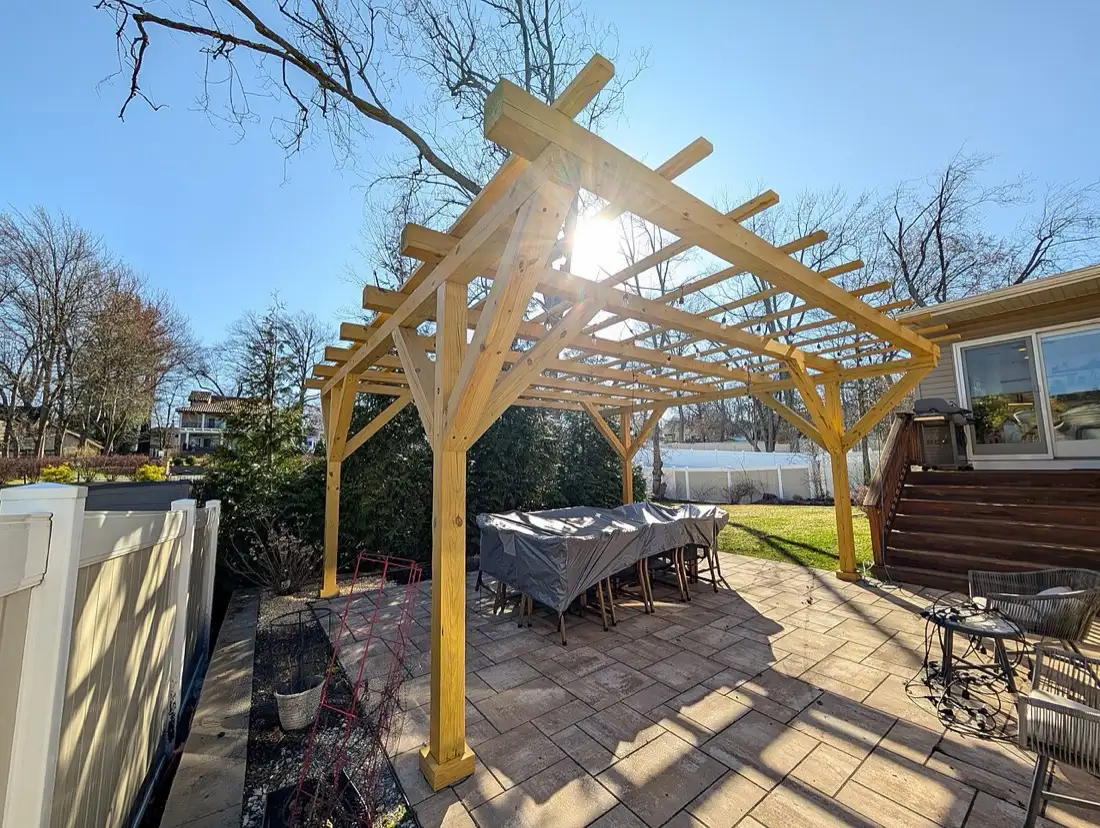
Do you need a permit for a pergola?
There is no single national answer, because the model codes do not give pergolas a line of their own. Cities sort them with three questions, and the answers decide whether you need nothing, a zoning permit, or a full building permit:
- Is it attached to the house? An attached pergola hangs on a ledger fastened to the wall, a structural connection the city wants to see.
- Is it open, or does it have a roof? Open rafters, lattice or shade cloth are treated differently from a solid or louvered roof that sheds water and holds snow.
- How big is it? Above a set area, a freestanding pergola becomes an accessory structure that needs a permit.
How real cities answer
| City | Rule for a residential pergola |
|---|---|
| Denver, Colorado | All covered pergolas, patios, porches and carports need a zoning permit and a building permit[1] |
| Fairfax County, Virginia | Freestanding: building permit over 256 square feet, and zoning location rules apply at any size; on a deck: may need a permit too[2] |
| Miami-Dade County, Florida | Pergolas and trellises that are non-roofed or non-wind-resistant are exempt from the building permit, but need a zoning improvement permit[3] |
| San Diego, California | Patio covers up to 300 square feet and 12 feet high are exempt, unless they encroach into a setback or sit in a coastal, planned, historic or sensitive area[4][5] |
| Prosper, Texas | Separate permit submittals for attached and detached arbors, pergolas and patio covers[6][7] |
| Santa Clarita, California | Patio covers and trellises are on the list of projects that need a building permit[9] |
Read the table as a spectrum. A 10 by 12 foot open cedar pergola in the middle of a Fairfax County yard needs no building permit; the same pergola with a louvered aluminum roof in Denver needs two permits.
Attached pergolas
Attaching changes the review because the city checks how the load reaches the house. Prosper requires an attachment detail with the bolt size, and the ledger must be fastened to the wall with fasteners run into the wall framing, or the pergola must bear on top of the roof past the top plate; attachments to the underside of the soffit or to the ends of the rafters are not allowed unless a registered design professional seals them[6]. San Diego's patio cover bulletin is just as clear: patio rafters may not be supported only by the existing rafter tails or fascia of the house[5].
Attached projects also bring the house's own rules into play. In Prosper, an attached structure must sit within the rear and side building lines of the property[6], the same lines the house respects.
Pergolas on decks
A pergola bolted to a deck rides on the deck's permit. Fairfax County reminds residents that decks require a building permit and that adding a pergola on top later may require a permit too, depending on the product and its dimensions; it suggests installing the deck and the pergola together under one building permit, and warns that a deck with a pergola often has to meet the same setbacks as the house[2].
Louvered and solid roofs
The roof is a line easily crossed without noticing. Miami-Dade's exemption covers only pergolas and trellises that are non-roofed or non-wind-resistant[3]. Denver requires zoning and building permits for every covered structure[1]. Once a pergola has a roof, many cities review it as a patio cover: San Diego's exemption for patio covers stops at 300 square feet of projected roof area, 12 feet in height and open on two or more sides, and separate electrical, mechanical and plumbing permits may still be required[5].
What the city asks for
For a permit, expect two drawings and sometimes a third:
- A site plan or survey with the pergola's location and its distances to every property line and to the house. Prosper also asks for the lot coverage, counting the house and every roofed structure[6]. Denver asks for existing structures and driveways, the proposed structure with its height, and the distances to structures and lot lines[1].
- A construction plan. Prosper asks for the size, height at the peak, post spacing, the foundation (piers or slab), the framing with lumber sizes and spans, and the attachment detail[6]. Denver lists the connection to the home, roof covering, rafter size and spacing, roof span, foundation, beam size and span, post size and connectors for covered projects[1].
- Kit documents. In Prosper, a premanufactured kit of 200 square feet or less can be submitted with its installation manual[7].
Two size steps matter in Prosper: plans over 400 square feet must be sealed by an architect, engineer or landscape architect, and a structure in metal or another material outside the scope of the residential code needs plans sealed by a Texas-licensed professional[7].
What a pergola permit costs
Fees are published by each city. Germantown, Wisconsin, charges $68.77 in 2026 for a detached gazebo or pergola over 100 square feet, plus a $42.32 plan review fee, a property record maintenance fee and a zoning compliance fee, and warns that one project can carry several fees, such as zoning and separate electrical permits[8]. Your permit file shows your own city's fees with the link to its schedule.
Building without a permit
Unpermitted outdoor structures are visible from the street and from the neighbors' windows. In Santa Clarita, a stop work order can be issued for unpermitted construction, and if work continues after it, the property owner is subject to fines and a lien on the property[9]. The All-in offer checks your city's rule, prepares the drawings and the forms, and follows the application until the permit is approved.
Common questions
Do I need a permit for a freestanding pergola?
Often not for a small open one, but every city sets its own line. Fairfax County, Virginia, requires a building permit for freestanding accessory structures over 256 square feet, and Miami-Dade County exempts non-roofed pergolas from the building permit while still requiring a zoning improvement permit.
Do I need a permit for a pergola attached to my house?
Plan on it. An attached pergola is a structural connection to the house: Prosper, Texas, has a dedicated attached pergola permit that asks for the ledger and bolt details, and Denver requires a zoning and building permit for every covered pergola.
Does a pergola on a deck need a permit?
It may. Fairfax County notes that decks need a building permit and that a pergola added on top later may need one too, depending on the product and its dimensions, and suggests building both under one permit.
Does a louvered or covered pergola count as a patio cover?
In many codes, a pergola with a roof is treated like a patio cover. San Diego exempts patio covers up to 300 square feet of roof area and 12 feet in height, unless they encroach into a setback or sit in a coastal, historic or environmentally sensitive area.
How much does a pergola permit cost?
It is set locally. In Germantown, Wisconsin, a detached gazebo or pergola over 100 square feet costs $68.77 in 2026, plus a $42.32 plan review fee and record maintenance and zoning fees.
We handle the permit. You build your pergola.
- Your city's rule, for your addressThe code section, its link and the date we checked it.
- Site plan and dimensioned drawingsDistances to your property lines, ready for the application.
- The form, where to file it, and the published feePlus the documents list and an HOA request template.
- Reviewed, then revised until approvedWith All-in, after every comment from the city, for up to 6 months.
Sources
- City and County of Denver, Colorado, Residential Decks, Porches, Patios, Pergolas, and Carports. Checked October 13, 2026.
- Fairfax County, Virginia, Department of Code Compliance, October 2025 Code Compliance Corner (pergolas and shade structures). Checked October 13, 2026.
- Miami-Dade County, Florida, Regulatory and Economic Resources, Permit Exemptions. Checked October 13, 2026.
- City of San Diego, California, Development Services, When is a Permit Required? (February 2025). Checked October 13, 2026.
- City of San Diego, California, Development Services, Information Bulletin 206, Patio Covers (March 2026). Checked October 13, 2026.
- Town of Prosper, Texas, Attached Arbor/Pergola/Patio Cover Permit Submittal (rev. 04/2025). Checked October 13, 2026.
- Town of Prosper, Texas, Detached Arbor/Pergola/Patio Cover Permit Submittal (rev. 04/2025). Checked October 13, 2026.
- Village of Germantown, Wisconsin, Building Inspection Services, Permit Application and Inspection Fees and Charges 2026. Checked October 13, 2026.
- City of Santa Clarita, California, Building and Safety, Stop Work Order Information. Checked October 13, 2026.