Above-ground pool permits, explained
Usually yes, once the pool can hold more than 24 inches of water. The International Residential Code only exempts prefabricated pools less than 24 inches deep, and many cities apply that line to soft-sided and inflatable pools too. Expect a site plan, a 48-inch barrier or a pool wall that acts as one, an electrical inspection and a fee.
Updated
Rather not do this yourself? We prepare your above-ground pool permit file for your address, and revise it until approved.
Get my permit · $399Key facts
- DeWitt still requires a zoning permit, usually at no charge, for pools that hold up to 24 inches.[3]City of DeWitt, Michigan, Building and Fees, Swimming pools and fences
- Westland requires overhead electrical wires to stay at least 18 feet above and 10 feet horizontally from the pool or deck wall, and Gates requires at least 10 feet from overhead electrical service lines.[6][5]City of Westland, Michigan, Residential Above Ground Swimming Pool Permit Application
- New York's code, quoted by East Syracuse, sets the top of the barrier at least 48 inches above grade, with no more than 2 inches between the ground and the bottom of the barrier.[2]Village of East Syracuse, New York, Swimming Pools
- Wisconsin Rapids requires pool electrical work to follow Article 680 of NFPA 70, the National Electrical Code.[4]City of Wisconsin Rapids, Wisconsin, Pool permit
- Consumer Product Safety Commission reports an average of 376 children under 15 fatally drowned in pool- or spa-related incidents each year from 2021 to 2023; nearly 80 percent were under five, and over 70 percent of the deaths happened in residential settings.[8]U.S. Consumer Product Safety Commission, CPSC Report Highlights Persistent Risk of…
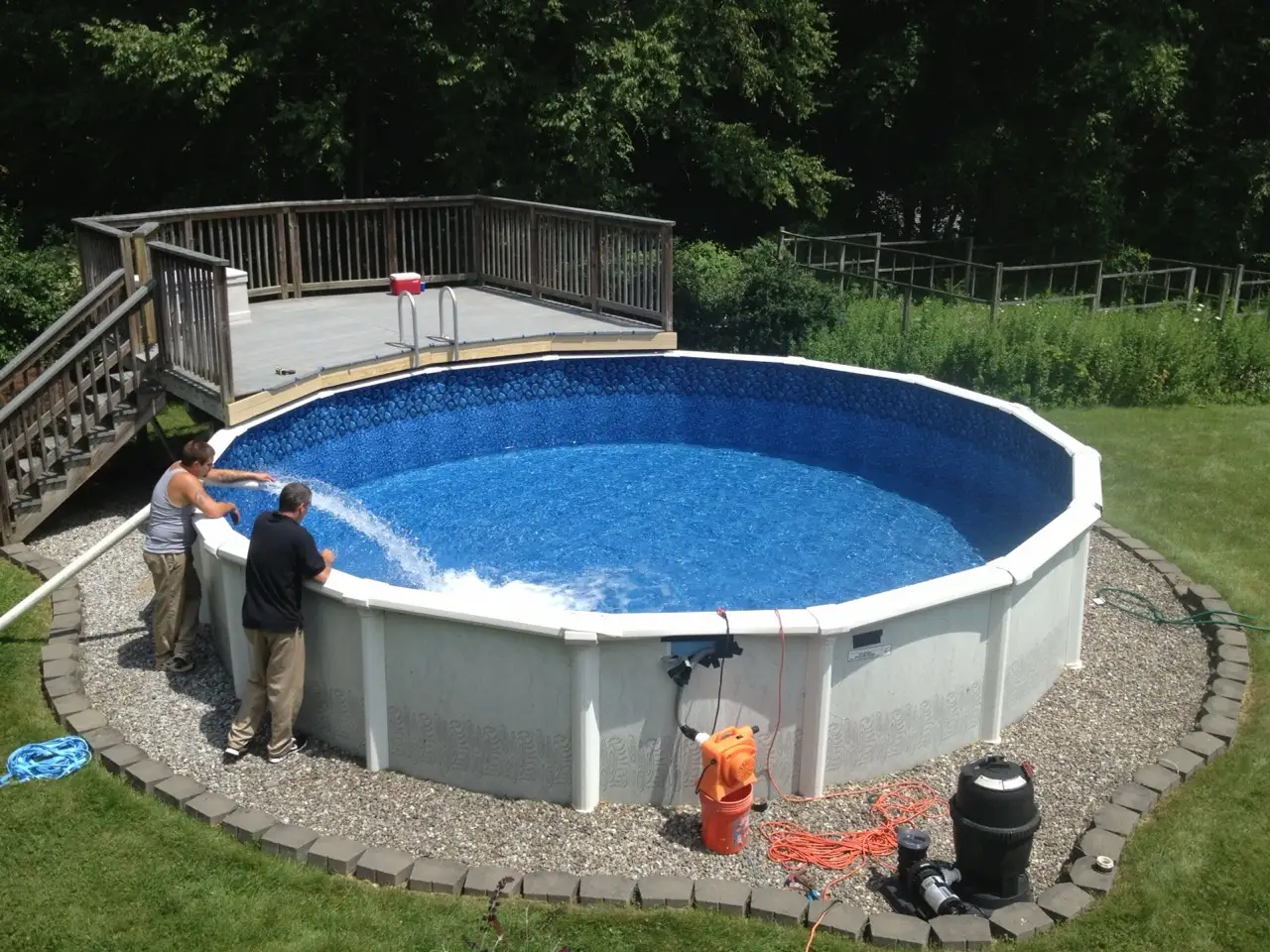
Do you need a permit for an above-ground pool?
Look at depth first, not price or brand. The International Residential Code (IRC) lists the work that needs no building permit in Section R105.2, and the only pool on that list is a prefabricated swimming pool less than 24 inches deep[1]. A pool that can hold more water than that is outside the exemption.
Cities that publish their pool rules draw the line in the same place, sometimes more strictly:
| City | When an above-ground pool needs a permit | Source |
|---|---|---|
| East Syracuse, New York | Any pool capable of holding water over 24 inches deep, inflatable pools included | Village pool page[2] |
| DeWitt, Michigan | Building permit over 24 inches; a zoning permit for pools up to 24 inches | City building page[3] |
| Wisconsin Rapids, Wisconsin | Any pool, except those up to 15 feet across with walls up to 15 inches that are taken down and stored off-season | City pool page[4] |
| Gates, New York | Every above-ground pool goes through the pool permit guidelines | Town guidelines[5] |
Two details catch people out. The rule is about what the pool can hold, not how full you plan to keep it. And the cheap end of the market is not exempt by default: East Syracuse warns that stores sell large kiddie pools that hold more than 24 inches of water with a small plug-in filter, and that these need the same permit, a code-compliant pool fence and a third-party electrical inspection before use[2].
Even below 24 inches you may not be entirely free. DeWitt still requires a zoning permit, usually at no charge, for pools that hold up to 24 inches[3]. Federal Way, Washington, which publishes the IRC exemption list, adds that separate permits may still be required for exempted items[1].
What the city asks for
An above-ground pool application is short, but it has to be complete. Three published checklists:
- Westland, Michigan: a site sketch showing lot lines, electrical lines and all structures, plus a copy of the manufacturer's installation instructions. A staking inspection is required before the pool goes in[6].
- Gates, New York: the building permit application, a survey map with the pool drawn on it and its distance from the house and lot lines, the pool's size with a brochure or website photo, and proof of insurance from a contractor, or the state's CE-200 exemption form if a homeowner, family member or friend installs it[5].
- Wisconsin Rapids, Wisconsin: a complete site plan showing setbacks, lot dimensions, existing structures and the pool location. It can be hand drawn or laid over an aerial image, and the owner must verify the property lines[4].
The site plan is the document that decides the outcome. It is where the city checks the distances below.
Where the pool can go
Placement rules are local and specific. Real published examples:
| City | Distance from property lines | Other location rules | Source |
|---|---|---|---|
| Westland, Michigan | 6 feet from adjoining lines, 25 feet from the front line | 10 feet from a side street or alley; 4 feet from any structure; never in an easement | Application[6] |
| Wisconsin Rapids, Wisconsin | 6 feet, or the accessory building setback if greater | Side or rear yard only; 10 feet from the house; 15 feet from a septic system; pump and filter 15 feet from lines | Pool page[4] |
| Gates, New York | 5 feet at the rear; 7 to 10 feet at the side depending on the zoning district | No pools in the front yard; 15 feet from any structure with a foundation; 20 feet from a well or septic | Guidelines[5] |
Overhead power lines matter too. Westland requires overhead electrical wires to stay at least 18 feet above and 10 feet horizontally from the pool or deck wall[6], and Gates requires at least 10 feet from overhead electrical service lines[5].
The barrier and the ladder
The barrier rule is the heart of every pool permit. New York's code, quoted by East Syracuse, sets the top of the barrier at least 48 inches above grade, with no more than 2 inches between the ground and the bottom of the barrier[2]. Where an above-ground pool structure is used as the barrier, the ladder or steps must be capable of being secured, locked or removed, or be surrounded by their own barrier[2].
DeWitt, Michigan, puts it in plain terms: a pool without side walls at least 4 feet high must be fenced, or have a fence or barrier mounted on top of the pool so that the pool is enclosed by at least 4 feet; a ladder or steps must be capable of being secured, locked or removed[3]. Wisconsin Rapids accepts the side wall as part of the barrier when it is 48 inches above the ground and the ladder or steps are removed or secured[4].
New York adds a requirement many owners miss: Gates states that every pool must be equipped with a pool alarm complying with ASTM F2208[5].
Electrical
The pump is the part that needs care. Wisconsin Rapids requires pool electrical work to follow Article 680 of NFPA 70, the National Electrical Code[4]. Westland forbids extension cords outright[6]. In East Syracuse, a third-party electrical inspection must be completed before the pool is used[2].
What an above-ground pool permit costs
Fees are published, and they vary a lot:
| City | Above-ground pool permit fee | Source |
|---|---|---|
| Wisconsin Rapids, Wisconsin | $40 | Pool page[4] |
| Gates, New York | $60 | Town guidelines[5] |
| Wharton, Texas | $360 for a pool or spa; $350 for a pool with a deck | Fee schedule[7] |
Your permit file shows your own city's fee, from its fee schedule, with the link.
Inspections
Expect at least one visit before you fill the pool. Westland requires a staking inspection to check the location[6]. Wisconsin Rapids leaves it to you to call the inspector, and warns that failing to call for the required inspections can lead to delays, costs and a fine[4].
Why the rules are strict
The barrier, ladder and alarm rules exist for one reason. The U.S. Consumer Product Safety Commission reports an average of 376 children under 15 fatally drowned in pool- or spa-related incidents each year from 2021 to 2023; nearly 80 percent were under five, and over 70 percent of the deaths happened in residential settings[8].
Skipping the permit
An unpermitted pool is easy to spot from the street or from the air, and the rules still apply to it. Wharton, Texas, lists a fee of $100 per day for working without a permit[7]. Wisconsin Rapids requires pools that existed before August 1, 2018, without compliant fencing to comply before water is put in them[4].
Our All-in offer prepares the file your city asks for, from the site plan with the real distances to the barrier details, and follows it until the permit is issued.
Common questions
Do I need a permit for an above-ground pool?
In most places that follow the International Residential Code, yes, if the pool can hold more than 24 inches of water. The model code exempts only prefabricated pools less than 24 inches deep. Some cities set a different line, so read your own city's pool page before you buy.
Does an inflatable or soft-sided pool need a permit?
It can. The Village of East Syracuse, New York, requires a building permit for every pool capable of holding water over 24 inches deep, inflatable pools included, and warns that some large store-bought pools with a plug-in filter fall under the same rules.
Can the pool wall count as the fence?
Often yes, if the wall is high enough and the ladder can be removed, locked or secured. DeWitt, Michigan, accepts an above-ground pool wall at least 4 feet high as the barrier, or a barrier mounted on top of the wall to reach 4 feet.
How much does an above-ground pool permit cost?
It depends on the city. Published examples include $40 in Wisconsin Rapids, Wisconsin, $60 in the Town of Gates, New York, and $360 in Wharton, Texas. Electrical permits can be separate.
Is the city's permit fee included in your price?
No. The permit fee is paid to your city or county. Your permit file shows the fee from your city's published fee schedule, with the link, before you file.
We handle the permit. You build your above-ground pool.
- Your city's rule, for your addressThe code section, its link and the date we checked it.
- Site plan and dimensioned drawingsDistances to your property lines, ready for the application.
- The form, where to file it, and the published feePlus the documents list and an HOA request template.
- Reviewed, then revised until approvedWith All-in, after every comment from the city, for up to 6 months.
Sources
- City of Federal Way, Washington, Residential permit exemptions (International Residential Code, Section R105.2). Checked October 13, 2026.
- Village of East Syracuse, New York, Swimming Pools (permit rule and New York State building code extracts). Checked October 13, 2026.
- City of DeWitt, Michigan, Building and Fees, Swimming pools and fences. Checked October 13, 2026.
- City of Wisconsin Rapids, Wisconsin, Pool permit (1 and 2 family residential). Checked October 13, 2026.
- Town of Gates, New York, Building Department, Above Ground Pool Permit Guidelines. Checked October 13, 2026.
- City of Westland, Michigan, Residential Above Ground Swimming Pool Permit Application (revised July 1, 2026). Checked October 13, 2026.
- City of Wharton, Texas, Residential Building Permit Fees. Checked October 13, 2026.
- U.S. Consumer Product Safety Commission, CPSC Report Highlights Persistent Risk of Childhood Drowning (June 24, 2026). Checked October 13, 2026.