How to install an above-ground pool
Pick a level spot that meets your city's setbacks and stays clear of overhead lines, septic systems and easements. Get the permit, have utilities marked, clear and level the ground, assemble the wall and liner exactly as the manufacturer's instructions say, have the pump wired under the electrical code, set up a compliant barrier and ladder, pass the inspections, then fill.
Updated
Rather not do this yourself? We prepare your above-ground pool permit file for your address, and revise it until approved.
Get my permit · $399Key facts
- In Wisconsin Rapids, the ground area of a pool must not exceed 30 percent of the rear and side yards.[1]City of Wisconsin Rapids, Wisconsin, Pool permit
- Wisconsin Rapids makes the owner responsible for verifying property line locations and recommends a professional surveyor when they are unknown.[1]City of Wisconsin Rapids, Wisconsin, Pool permit
- Westland asks for a site sketch with lot lines, electrical lines and all structures, plus the manufacturer's installation instructions.[2]City of Westland, Michigan, Residential Above Ground Swimming Pool Permit Application
- In Gates, New York, a homeowner who installs the pool, or a friend or family member who helps, files the state's CE-200 form instead of a contractor's insurance certificate.[3]Town of Gates, New York, Building Department, Above Ground Pool Permit Guidelines
- Do not cut corners on the wall joints or the uprights: if the wall will serve as the safety barrier, the pool structure must be capable of withstanding the loads put on it as a barrier.[5]Village of East Syracuse, New York, Swimming Pools
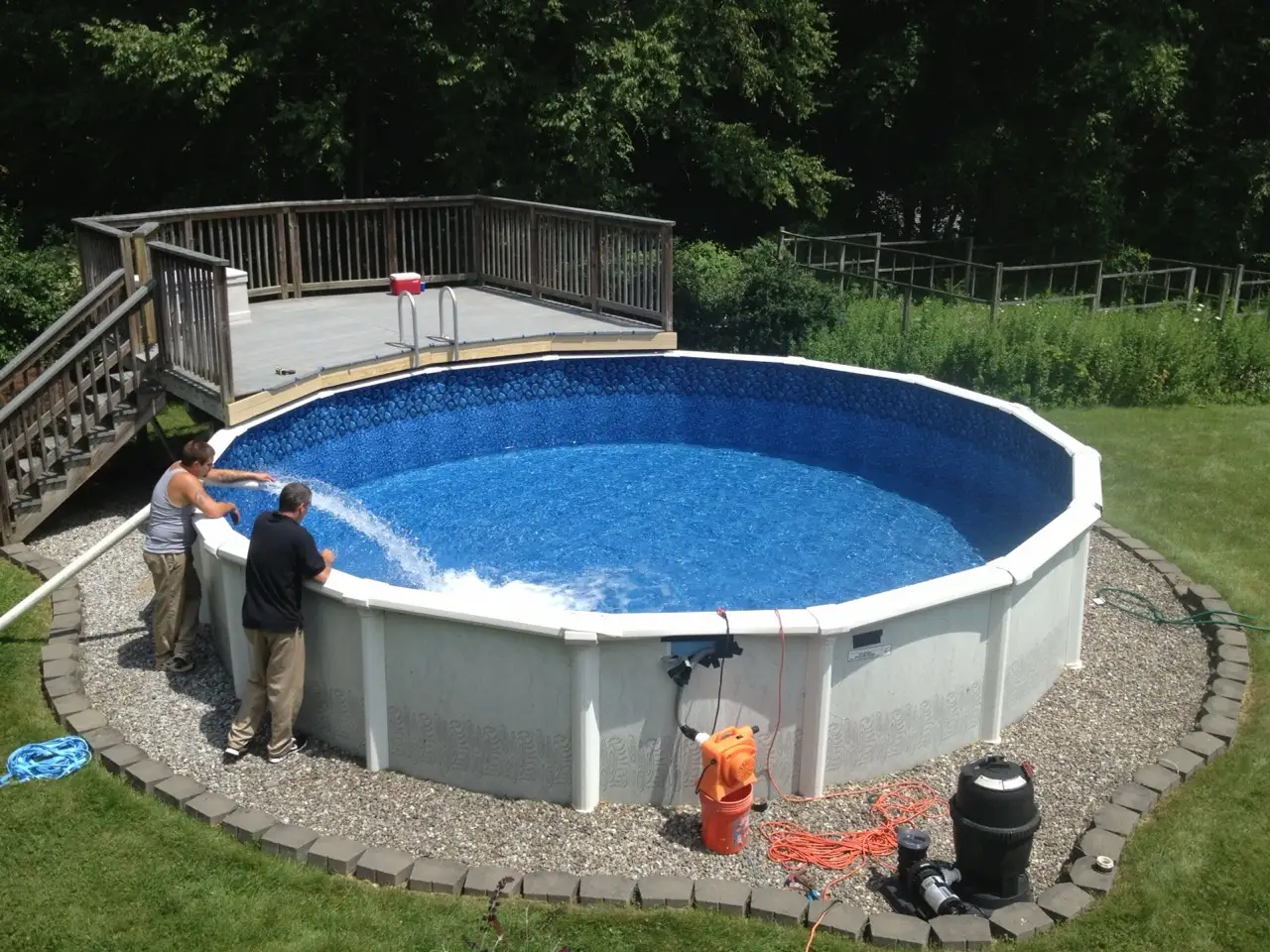
Before you buy: what the pool will need
An above-ground pool is sold as a weekend project, and the assembly often is. The part that takes planning is everything around it: the spot, the power, the barrier and the paperwork. Decide those before you order, because they can change the size of pool you can use.
Three questions settle most of it:
- How deep will it be? The International Residential Code only exempts prefabricated pools less than 24 inches deep from a building permit[6]. Most family-size above-ground pools are deeper, so plan on a permit.
- How high is the wall? A wall of at least 48 inches can often serve as the safety barrier; a lower wall means a fence or a barrier on top of the wall[4][1].
- Where does the power come from? The pump needs a proper circuit, not a cord across the lawn[2].
Step 1: Choose a spot the city will accept
The best spot for the pool is the one that passes the site plan review. Typical published rules:
| Rule | Example | Source |
|---|---|---|
| Yard | Side or rear yard only; no pools in front yards | Wisconsin Rapids[1], Gates[3] |
| Property lines | 6 feet from adjoining lines and 25 feet from the front line | Westland[2] |
| House and buildings | 10 feet from the house; 15 feet from any structure with a foundation | Wisconsin Rapids[1], Gates[3] |
| Septic and wells | 15 feet from a septic tank or field; 20 feet from a well or septic | Wisconsin Rapids[1], Gates[3] |
| Overhead wires | 18 feet vertically and 10 feet horizontally from the pool or deck wall | Westland[2] |
| Easements | No pool in an easement | Westland[2], Gates[3] |
| Pump and filter | 15 feet from property boundary lines | Wisconsin Rapids[1] |
Size can be capped too: in Wisconsin Rapids, the ground area of a pool must not exceed 30 percent of the rear and side yards[1].
Measure from the real property lines, not from the fence. Wisconsin Rapids makes the owner responsible for verifying property line locations and recommends a professional surveyor when they are unknown[1].
Step 2: Get the permit before the ground work
Apply with the site plan, the pool's size and the manufacturer's information. Westland asks for a site sketch with lot lines, electrical lines and all structures, plus the manufacturer's installation instructions[2]. In Gates, New York, a homeowner who installs the pool, or a friend or family member who helps, files the state's CE-200 form instead of a contractor's insurance certificate[3]. Westland also requires a staking inspection, so the inspector sees the location before the pool goes in[2].
Step 3: Have buried utilities marked
Leveling a pool site means digging, even if only a few inches. Wisconsin Rapids makes the permit holder responsible for contacting the state's one-call service, Diggers Hotline, before any digging[1]. Every state has an equivalent you reach by calling 811.
Step 4: Clear and level the base
The pool sits on a flat, level base cut into the ground, not on a mound of fill. Remove the sod and organic material, and level the area to the tolerance the manufacturer's instructions give. Those instructions are the standard here, and Westland files a copy of them with the permit[2]. Follow the manufacturer's base material and thickness, and the wall track or bottom rail layout, exactly.
Step 5: Assemble the wall, liner and frame
Follow the manufacturer's sequence for the bottom track, wall, liner, top rails and uprights. Do not cut corners on the wall joints or the uprights: if the wall will serve as the safety barrier, the pool structure must be capable of withstanding the loads put on it as a barrier[5].
Step 6: Power the pump the right way
The circulation pump is the one part of the project that is electrical work. Wisconsin Rapids requires pool electrical work to follow Article 680 of NFPA 70, the National Electrical Code[1]. Westland forbids extension cords for pools[2]. In East Syracuse, New York, a third-party electrical inspection must be completed before a pool is used[5]. Check whether your city wants a separate electrical permit and who may do the work.
Step 7: Set up the barrier and the ladder
This is where the inspection is won or lost.
- The barrier height: at least 48 inches above grade, measured on the side away from the pool, with no more than 2 inches between the ground and the bottom of the barrier, under New York's code[5].
- The pool wall as the barrier: accepted in Wisconsin Rapids when the wall is 48 inches above the ground and the ladder or steps are removed or secured[1]. In DeWitt, Michigan, a wall under 4 feet means a fence, or a barrier mounted on top of the wall to reach 4 feet[4].
- The ladder: it must be capable of being secured, locked or removed, or be surrounded by its own barrier[5]. Gates, New York, asks that the safety ladder be removed and secured when the pool is not in use[3].
- Climbable objects: Gates asks owners to remove anything within 5 feet that could be used to climb over the barrier or pool wall[3]. That includes the pump housing, a picnic table or a stack of chairs.
- The alarm in New York: Gates states that every pool must have a pool alarm complying with ASTM F2208[3].
A deck built against the pool changes the barrier, because it gives a way in at the top of the wall. Treat it as its own project with its own permit; see how to build a deck.
Step 8: Pass the inspections, then fill
Call for the inspections your permit lists before you fill the pool. Wisconsin Rapids warns that failing to call for the required inspections can lead to delays, costs and a fine[1].
Step 9: Plan where the water goes
At the end of the season, or when you replace the liner, the water must go somewhere legal. Wisconsin Rapids forbids letting it flow onto adjoining property without the owner's explicit approval, into a wetland or a navigable waterbody, or into a sanitary sewer without the public works director's approval[1].
Do you need a permit to install an above-ground pool?
Most of the steps above are what an inspector checks. Getting the permit first means the site plan, the barrier and the wiring are agreed before you spend a weekend leveling the wrong spot. The details, fees and city examples are on the above-ground pool permit page, and the common reasons applications come back are on why above-ground pool permits get rejected.
Our All-in offer prepares that file for your address and follows it until your city issues the permit.
Common questions
Where should I put an above-ground pool?
On level ground in the side or rear yard, outside every setback and easement, away from overhead power lines and septic systems. Wisconsin Rapids, Wisconsin, for example, requires 10 feet from the house, 6 feet from property lines and 15 feet from a septic system.
Can I plug the pool pump into an extension cord?
Not in Westland, Michigan, where extension cords are strictly forbidden for pools. Pool wiring falls under Article 680 of the National Electrical Code, and several cities require an electrical permit or inspection before the pool is used.
Do I need a fence around an above-ground pool?
Not always. Many cities accept a pool wall at least 48 inches high as the barrier if the ladder or steps can be removed, locked or secured. Lower walls need a fence, or a barrier mounted on top of the wall.
Where does the water go when I drain the pool?
Follow your city's rules. Wisconsin Rapids, Wisconsin, forbids draining pool water onto a neighbor's property without their explicit approval, into a wetland or waterway, or into the sanitary sewer without the public works director's approval.
We handle the permit. You build your above-ground pool.
- Your city's rule, for your addressThe code section, its link and the date we checked it.
- Site plan and dimensioned drawingsDistances to your property lines, ready for the application.
- The form, where to file it, and the published feePlus the documents list and an HOA request template.
- Reviewed, then revised until approvedWith All-in, after every comment from the city, for up to 6 months.
Sources
- City of Wisconsin Rapids, Wisconsin, Pool permit (1 and 2 family residential). Checked October 13, 2026.
- City of Westland, Michigan, Residential Above Ground Swimming Pool Permit Application (revised July 1, 2026). Checked October 13, 2026.
- Town of Gates, New York, Building Department, Above Ground Pool Permit Guidelines. Checked October 13, 2026.
- City of DeWitt, Michigan, Building and Fees, Swimming pools and fences. Checked October 13, 2026.
- Village of East Syracuse, New York, Swimming Pools (permit rule and New York State building code extracts). Checked October 13, 2026.
- City of Federal Way, Washington, Residential permit exemptions (International Residential Code, Section R105.2). Checked October 13, 2026.