Chicken coop permits, explained
Often you need two approvals, not one: permission to keep hens, and a building permit for the coop once it passes a size line. Under the International Residential Code, a detached one-story accessory structure up to 200 square feet is exempt from a building permit, but cities like Chandler, Arizona, require one above 120 square feet.
Updated
Rather not do this yourself? We prepare your chicken coop permit file for your address, and revise it until approved.
Get my permit · $399Key facts
- In Federal Way, owning the hens needs no permit, but a coop over 200 square feet needs a building permit.[2]City of Federal Way, Washington, Community Development, Bulletin 75, Backyard…
- The model International Residential Code (IRC), Section R105.2, exempts one-story detached accessory structures whose floor area does not exceed 200 square feet.[1]City of Federal Way, Washington, Residential permit exemptions
- A coop that fits 10 feet from every line on a wide lot may not fit at all on a narrow one, and in Grand Rapids the coop and its covered enclosure together cannot cover more than half of the rear yard.[5]City of Grand Rapids, Michigan, Backyard Chicken Permit
- In Orlando, the extension class costs $20 per household and the permit fee is $50, due once the application is approved.[4]City of Orlando, Florida, Apply for a Backyard Chicken Permit
- If your house has a homeowners association, ask it too: Chandler tells residents to check with their HOA whether chickens are permitted in the community.[3]City of Chandler, Arizona, Backyard Chickens
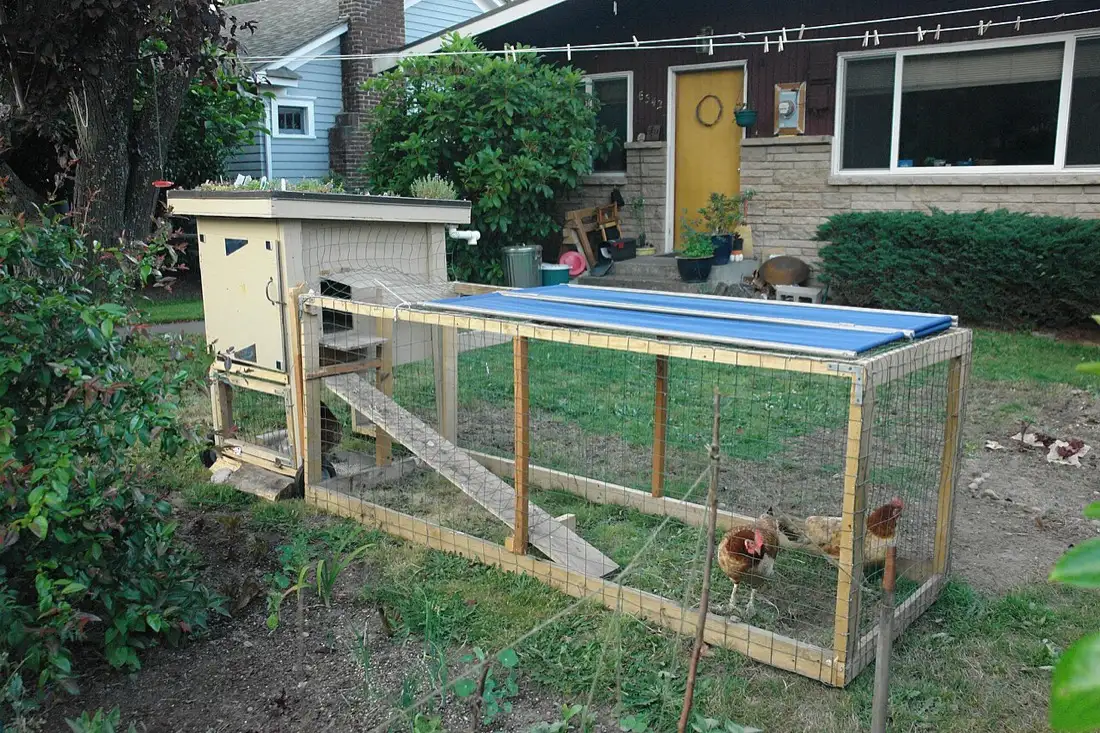
Do you need a permit for a chicken coop?
A backyard flock usually touches two different rulebooks, and people miss the second one.
- The animals. Zoning or animal-control rules decide whether you may keep hens at all, how many, and where. Some cities issue a chicken permit, some ask for a registration, some ask for nothing. Orlando, Florida, issues Backyard Chicken Permits[4]; Blaine, Minnesota, requires every chicken operation to be registered with the city before the birds arrive[6]; Federal Way, Washington, requires no permit or license to own chickens or ducks[2].
- The structure. The coop is a building. Under the building code it needs a permit once it is big enough, or as soon as it has utilities.
Getting the first approval does not settle the second. In Federal Way, owning the hens needs no permit, but a coop over 200 square feet needs a building permit[2].
When the coop itself needs a building permit
The model International Residential Code (IRC), Section R105.2, exempts one-story detached accessory structures whose floor area does not exceed 200 square feet[1]. A coop under that size is exempt from the building permit in a city that uses the model rule as written. Two limits come with it. Federal Way, which publishes the list, says work in a critical area such as wetlands, streams or landslide hazard areas and their buffers is not exempt, and that separate permits may still be required for exempted items[1].
Many cities draw the line lower, or add triggers of their own:
| Typical trigger | Real city rule |
|---|---|
| Floor area over 200 square feet | Federal Way: coops exceeding 200 square feet require a building permit[2] |
| Floor area over 120 square feet | Chandler, Arizona: the coop is treated as an accessory building, needs a building permit, must meet accessory setbacks and stay under 15 feet tall[3] |
| Electricity or water | Chandler: any coop connected to utilities needs a building permit regardless of size[3] |
| A size cap, not a permit line | Orlando: coop and run under 50 square feet[4]; Blaine: coop and covered run no more than 60 square feet[6] |
| Plans with the chicken permit | Grand Rapids, Michigan: upload plans of the coop, such as drawings, photos, elevations or the info sheet of a pre-made coop[5] |
A heated waterer, a light on a timer or a hose bib is enough to cross the utilities line in Chandler, so decide early whether the coop will be wired.
Where the coop can go
Location is where most backyard flocks are won or lost. The numbers vary a lot from one city to the next, which is why a rule copied from another town's forum is not safe:
| City | Where | Distances |
|---|---|---|
| Orlando, Florida | Behind the house, in the backyard | 20 feet from neighboring homes, 5 feet from your house and from the property line[4] |
| Blaine, Minnesota | Rear yard only | 5 feet from side or rear lot lines, 30 feet from an adjacent home's living space[6] |
| Grand Rapids, Michigan | Rear yard only | 10 feet from all property lines[5] |
| Chandler, Arizona | Rear and side yards | 5 feet from any property line; coop no taller than the surrounding property wall[3] |
| Federal Way, Washington | Not between the house and the front property line | 10 feet from side and rear property lines[2] |
| Seattle, Washington | Per the yard rules | 10 feet from any residential structure on an adjacent lot[7] |
Your lot shape decides the rest. A coop that fits 10 feet from every line on a wide lot may not fit at all on a narrow one, and in Grand Rapids the coop and its covered enclosure together cannot cover more than half of the rear yard[5].
How many hens, and no roosters
| City | Flock limit | Roosters |
|---|---|---|
| Orlando | 4 hens; single-family homes only[4] | Not allowed[4] |
| Chandler | Up to 5 chickens on a detached single-family lot since January 5, 2023[3] | Prohibited[3] |
| Grand Rapids | 4 on lots under 5,000 square feet, 6 above; lot of at least 3,800 square feet[5] | Prohibited[5] |
| Blaine | 6 hens[6] | Not allowed[6] |
| Federal Way | 4 on lots under 35,000 square feet, up to 20 above[2] | Only for farming uses in Suburban Estate zones[2] |
| Seattle | 8 domestic fowl[7] | Not permitted[7] |
What the city asks for
The paperwork for a chicken permit is light compared with a deck, but it is real paperwork.
- A site plan. Grand Rapids asks for a drawing of the coop and yard with measurements and all existing buildings on the lot, and offers a template[5]. Blaine asks for the distance from the coop to the property lines and to neighboring homes, and the coop's dimensions[6].
- Plans or photos of the coop. Grand Rapids accepts building plans, photos, elevation drawings or the info sheet of a pre-manufactured coop[5]. Orlando asks for photos of the proposed site[4].
- A class. Orlando requires a University of Florida extension class covering nutrition, breeds, biosecurity, egg production and proper coop construction, and proof of completion with the application[4].
- A building permit application on top, if the coop crosses your city's size or utilities line[3].
What it costs and how long it takes
Fees are set by each city and published. In Orlando, the extension class costs $20 per household and the permit fee is $50, due once the application is approved[4]. Grand Rapids charges a non-refundable application fee, paid by card when you apply online[5].
Reviews of the chicken permit are quick in the cities that state it: Orlando emails within one business day to discuss permit availability[4], Grand Rapids expects to give feedback within one to two business days[5], and Blaine lists a typical review period of three days[6]. A building permit for a larger coop follows the normal building review of your city.
Before you buy the birds
Check the rules for your exact address first, then size and place the coop to fit them. If your house has a homeowners association, ask it too: Chandler tells residents to check with their HOA whether chickens are permitted in the community[3]. The All-in offer handles this for you, from the rule research to the filed application and the city's follow-up questions.
Common questions
Do I need a permit to build a chicken coop?
It depends on two things, the birds and the building. Many cities regulate the hens with a chicken permit or a registration, and the coop itself needs a building permit once it is large enough or has utilities. In Chandler, Arizona, coops over 120 square feet, and any coop connected to electricity or water, need a building permit.
How big can a chicken coop be without a building permit?
The model International Residential Code exempts one-story detached accessory structures of 200 square feet or less, and Federal Way, Washington, uses that line for coops. Chandler, Arizona, sets it lower, at 120 square feet. Some cities cap the size outright, such as Orlando, Florida, where the coop and run must be under 50 square feet.
How far does a chicken coop have to be from my neighbor?
Each city sets its own distances. Orlando asks for at least 20 feet from neighboring homes, Blaine, Minnesota, for at least 30 feet from an adjacent home's living space, and Seattle for at least 10 feet from any residential structure on an adjacent lot.
Can I keep a rooster?
Usually not in town. Chandler, Orlando, Grand Rapids, Blaine and Seattle all prohibit roosters, and Federal Way allows them only for typical farming uses in its Suburban Estate zones.
How much does a chicken permit cost?
Orlando charges a $50 permit fee once the application is approved, plus a $20 class per household with the University of Florida extension office. Other cities publish their own fees; your permit file shows the fee from your city's schedule.
We handle the permit. You build your chicken coop.
- Your city's rule, for your addressThe code section, its link and the date we checked it.
- Site plan and dimensioned drawingsDistances to your property lines, ready for the application.
- The form, where to file it, and the published feePlus the documents list and an HOA request template.
- Reviewed, then revised until approvedWith All-in, after every comment from the city, for up to 6 months.
Sources
- City of Federal Way, Washington, Residential permit exemptions (International Residential Code, Section R105.2). Checked October 13, 2026.
- City of Federal Way, Washington, Community Development, Bulletin 75, Backyard Chickens/Ducks (June 5, 2022). Checked October 13, 2026.
- City of Chandler, Arizona, Backyard Chickens. Checked October 13, 2026.
- City of Orlando, Florida, Apply for a Backyard Chicken Permit. Checked October 13, 2026.
- City of Grand Rapids, Michigan, Backyard Chicken Permit. Checked October 13, 2026.
- City of Blaine, Minnesota, Chicken Permit. Checked October 13, 2026.
- City of Seattle, Department of Construction and Inspections, Tip 244, Urban Agriculture (updated May 27, 2022). Checked October 13, 2026.