Why chicken coop permits get refused
Chicken and coop permits are refused for written reasons: a property type or lot size the city excludes, more hens than allowed or a rooster, a coop in the front yard or too close to a neighbor's home, a coop over the size or height cap, utilities without a building permit, or a missing class, site plan or registration.
Updated
Rather not do this yourself? We prepare your chicken coop permit file for your address, and revise it until approved.
Get my permit · $399Key facts
- Orlando issues chicken permits only to single-family homes and does not allow chickens in community gardens.[1]City of Orlando, Florida, Apply for a Backyard Chicken Permit
- Grand Rapids requires the property to be at least 3,800 square feet, then ties the flock to the lot: no more than four chickens under 5,000 square feet, six above.[2]City of Grand Rapids, Michigan, Backyard Chicken Permit
- Chandler requires droppings to be removed from coops at least twice a week and keeps coops to a structurally sound, blight-free condition, rules a neighbor can report.[3]City of Chandler, Arizona, Backyard Chickens
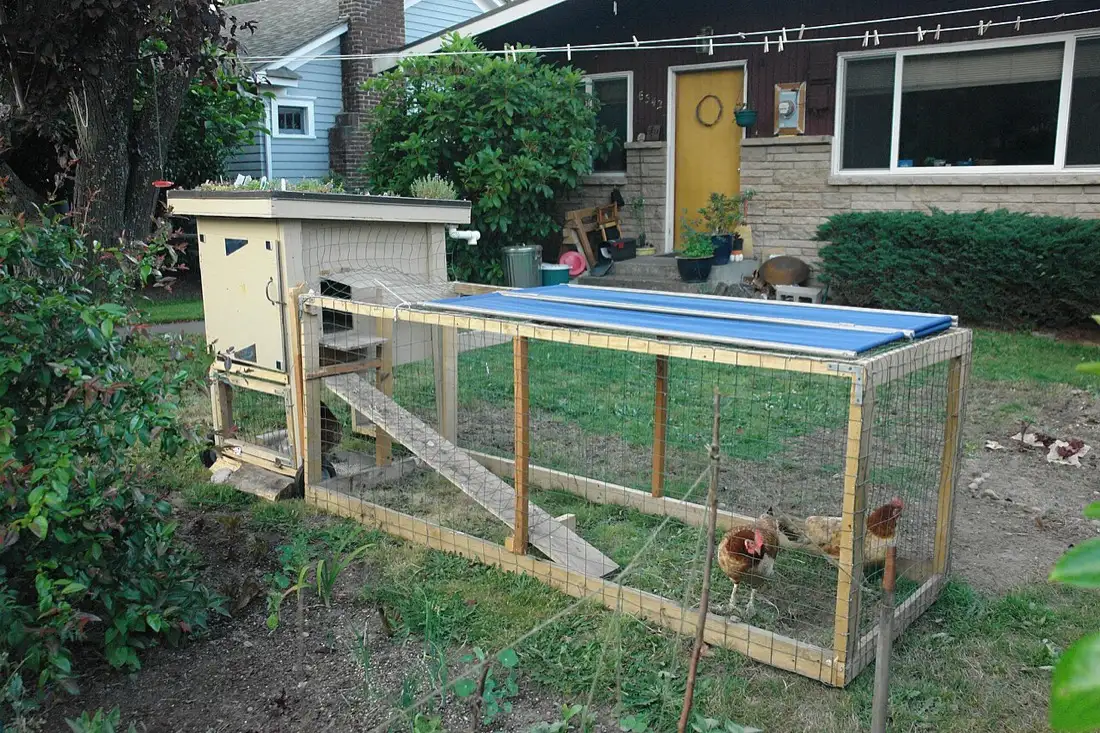
Why do chicken permits get refused?
A chicken permit is checked against a short list of written conditions. If one is not met, the answer is no, or a request to change the plan. Here are the reasons that come back again and again, with the city rule behind each one.
| Reason | The rule | Example |
|---|---|---|
| Wrong type of home | Hens only at detached single-family homes | Orlando: no duplex, triplex, townhome or multifamily properties[1] |
| Lot too small | A minimum lot area to apply | Grand Rapids: at least 3,800 square feet[2] |
| Too many birds | A flock limit tied to the lot | Federal Way: 4 on lots under 35,000 square feet[5]; Chandler: 5[3] |
| A rooster | Roosters banned in town | Orlando, Chandler, Grand Rapids, Blaine, Seattle[1][3][2][4][6] |
| Coop in the wrong yard | Rear or side yard only | Blaine: rear yard only[4]; Federal Way: not between the house and the front property line[5] |
| Too close to a neighbor | Distance from homes and lot lines | Blaine: 30 feet from an adjacent home's living space[4] |
| Coop too big or too tall | Size or height caps | Orlando: under 50 square feet[1]; Grand Rapids: 8 feet tall, 6 square feet per chicken[2] |
| Missing pieces | Class, site plan, plans, photos | Orlando: proof of class completion[1]; Grand Rapids: site plan with measurements[2] |
The rules behind most refusals
The property is not eligible
Before anyone looks at the coop, the city checks the lot. Orlando issues chicken permits only to single-family homes and does not allow chickens in community gardens[1]. Grand Rapids requires the property to be at least 3,800 square feet, then ties the flock to the lot: no more than four chickens under 5,000 square feet, six above[2]. No design fixes an ineligible lot, so this is the first thing to check.
Too many birds, or the wrong ones
Flock limits are counted strictly. Federal Way allows any combination of four chickens and ducks on lots under 35,000 square feet and up to 20 on larger lots[5]; Seattle allows up to eight domestic fowl[6]; Blaine allows six hens[4]. Roosters are where many applications die: Orlando also excludes ducks, geese, turkeys, peafowl and pigeons[1], and Grand Rapids prohibits roosters regardless of the age or maturity of the bird[2]. Federal Way adds a practical warning: verify that chicks are hens before you buy them[5].
The coop is in the wrong place
Most refusals that are not about the birds are about distances. Blaine requires the coop in the rear yard, 5 feet from side or rear lot lines and 30 feet from an adjacent home's living space[4]. Orlando asks for 20 feet from neighboring homes and 5 feet from your own house and the property line[1]. Seattle measures 10 feet from any residential structure on an adjacent lot[6]. On a narrow lot, the neighbor's house can make the whole back yard unusable, which is why the site plan matters more than the coop design.
The coop is too big, too tall or wired
Size caps differ by city and are often small. Orlando wants the coop and run under 50 square feet and tied down for wind[1]; Blaine caps the coop and covered run at 60 square feet[4]; Grand Rapids allows one coop, no taller than 8 feet, with no more than 6 square feet per chicken, and the coop and covered enclosure cannot cover more than half of the rear yard[2]. In Chandler, a coop over 120 square feet becomes an accessory building that needs a building permit and must meet accessory building setbacks, and any coop connected to electricity or water needs a building permit regardless of size[3].
The application is incomplete
Each city has its own checklist. Orlando requires photos of the proposed site, a site plan and proof that you took the University of Florida extension class[1]. Grand Rapids wants a site plan with measurements showing every existing building, plans or photos of the coop, and warns that you may need to revise the application if staff notice missing or incorrect information[2]. Blaine's registration needs a site and building plan with the coop's location, dimensions and setbacks[4].
Chicken wire
A detail that surprises people: Orlando requires a coop secured against predators and does not allow chicken wire[1]. Federal Way recommends half-inch hardware cloth for the same reason[5].
What happens if you skip the permit
The birds and the coop can both become an enforcement problem. Chandler requires droppings to be removed from coops at least twice a week and keeps coops to a structurally sound, blight-free condition[3], rules a neighbor can report. For the structure, cities treat a large coop like any accessory building: Santa Clarita, California, requires a building permit for accessory structures over 120 square feet, can issue a stop work order for unpermitted construction, and fines the owner and places a lien on the property if work continues after the order[7].
How to get it approved the first time
- Confirm that your property type and lot size are eligible[1][2].
- Count your flock against the limit and leave out the rooster[5].
- Draw a site plan with the distances to every property line and to the neighbors' homes[2][4].
- Size the coop to the city's cap, or plan the building permit if you go bigger[3].
- Use hardware cloth, not chicken wire, where the city requires it[1].
- Take the required class before you apply, if your city has one[1].
- Ask your homeowners association first if you have one[3].
The All-in offer does these steps for your address: the rules with links, the site plan, the coop drawings and the forms, then our follow-up with the city until approval, with our money-back guarantee if the city refuses for a written requirement we should have caught.
Common questions
Why can't I keep chickens in my townhouse?
Because some cities limit backyard hens to detached single-family homes. Orlando, Florida, does not allow chickens on duplex, triplex, townhome or multifamily properties, and Chandler, Arizona, allows them on detached single-family lots.
My lot is small. Can I still get a chicken permit?
Check the minimum lot size first. Grand Rapids, Michigan, requires a property of at least 3,800 square feet to apply, and allows four chickens under 5,000 square feet and six above.
The city says my coop is too big. What now?
Shrink it to the cap or apply for the building permit the larger size requires. Orlando caps the coop and run under 50 square feet, Blaine, Minnesota, at 60 square feet, while Chandler, Arizona, accepts larger coops as accessory buildings with a building permit above 120 square feet.
Does the HOA have to agree as well?
If your community has one, ask it before you apply. Chandler tells residents to check with their homeowners association whether chickens are permitted in their community; a city permit does not override the association's own rules.
We handle the permit. You build your chicken coop.
- Your city's rule, for your addressThe code section, its link and the date we checked it.
- Site plan and dimensioned drawingsDistances to your property lines, ready for the application.
- The form, where to file it, and the published feePlus the documents list and an HOA request template.
- Reviewed, then revised until approvedWith All-in, after every comment from the city, for up to 6 months.
Sources
- City of Orlando, Florida, Apply for a Backyard Chicken Permit. Checked October 13, 2026.
- City of Grand Rapids, Michigan, Backyard Chicken Permit. Checked October 13, 2026.
- City of Chandler, Arizona, Backyard Chickens. Checked October 13, 2026.
- City of Blaine, Minnesota, Chicken Permit. Checked October 13, 2026.
- City of Federal Way, Washington, Community Development, Bulletin 75, Backyard Chickens/Ducks (June 5, 2022). Checked October 13, 2026.
- City of Seattle, Department of Construction and Inspections, Tip 244, Urban Agriculture (updated May 27, 2022). Checked October 13, 2026.
- City of Santa Clarita, California, Building and Safety, Stop Work Order Information. Checked October 13, 2026.