How to build a chicken coop
Size the coop for your flock, about 3 square feet per bird with a run or 8 to 10 without one, then raise it a foot off the ground, give it draft-free ventilation, roosts and one nest box per four hens, and wrap the run in sturdy buried mesh. Check your city's flock limit, setbacks and size caps before you cut any wood.
Updated
Rather not do this yourself? We prepare your chicken coop permit file for your address, and revise it until approved.
Get my permit · $399Key facts
- Oregon State University Extension recommends at least 3 square feet per bird if the hens have a run or outdoor area, and 8 to 10 square feet per bird if they have no outdoor access.[1]Oregon State University Extension Service, Living on the land, Backyard chicken coop…
- Orlando wants the coop behind the house, 20 feet from neighboring homes and 5 feet from your house and the property line; Grand Rapids wants it in the rear yard, 10 feet from all property lines.[3][4]City of Orlando, Florida, Apply for a Backyard Chicken Permit
- Orlando requires coops to be tied down for wind resistance.[3]City of Orlando, Florida, Apply for a Backyard Chicken Permit
- The model International Residential Code exempts one-story detached accessory structures of 200 square feet or less from a building permit, but cities can be stricter: Chandler draws the line at 120 square feet, and Federal Way requires a building permit above 200 square feet.[7][5][2]City of Federal Way, Washington, Residential permit exemptions
- On the animal side, Blaine wants every chicken operation registered before the birds arrive, and Grand Rapids wants a site plan and coop plans with the permit application.[6][4]City of Blaine, Minnesota, Chicken Permit
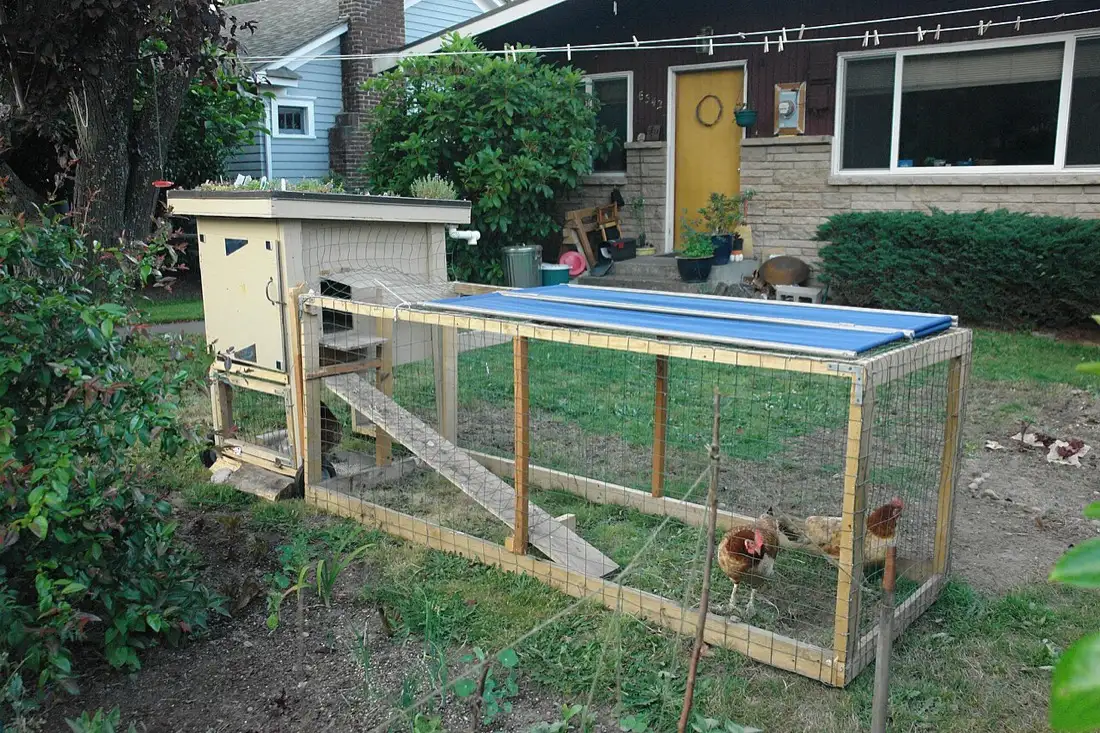
Plan before you build
A coop is a small building with three jobs: keep the hens dry and ventilated, keep predators out, and stay easy to clean. Get the size and the spot right on paper first, because those two decisions are the ones the city checks.
How big?
Oregon State University Extension recommends at least 3 square feet per bird if the hens have a run or outdoor area, and 8 to 10 square feet per bird if they have no outdoor access[1]. Federal Way, Washington, gives a similar rule of thumb: 3 to 6 square feet of indoor shelter and 3 to 6 square feet of outdoor shelter per bird, so a coop with the maximum space for four birds measures 48 square feet[2].
Then compare with your city's cap, because some are tight:
| City | Size rule for the coop |
|---|---|
| Orlando, Florida | Coop and run together under 50 square feet[3] |
| Blaine, Minnesota | Coop and covered run no more than 60 square feet[6] |
| Grand Rapids, Michigan | No more than 6 square feet per chicken, 8 feet tall at most[4] |
| Chandler, Arizona | Over 120 square feet, the coop needs a building permit[5] |
Four hens in Orlando means a compact coop with an integrated run, not a garden shed.
Where?
Pick a spot that meets your city's distances before you think about sun and shade. Orlando wants the coop behind the house, 20 feet from neighboring homes and 5 feet from your house and the property line[3]; Grand Rapids wants it in the rear yard, 10 feet from all property lines[4]. Oregon State adds a practical rule: avoid large plants around the coop, because they can shelter predators[1].
Step by step
1. Raise the floor
Oregon State recommends raising the coop at least 1 foot off the ground to discourage rats, snakes, raccoons and skunks, with secure flooring such as a concrete slab or solid wood[1]. A sloped floor that drains well makes hosing out the coop much easier[1].
2. Anchor it
Light coops move in storms. Orlando requires coops to be tied down for wind resistance[3]. Ground anchors or a frame fixed to piers do the job; plan the anchors before you build the floor.
3. Frame, walls and roof
Build a simple framed box with a roof that sheds water and a door you can open wide. Oregon State suggests hanging doors so they open toward the outside, which makes it easier to clean every corner[1]. Grand Rapids caps the coop at 8 feet tall[4], and Chandler keeps it no taller than the surrounding property wall[5], so check the height before you pick a roof pitch.
4. Ventilation without drafts
Ventilation removes ammonia fumes, carbon dioxide and moisture. Oregon State says passive ventilation, through openings such as windows or vents in gables, eaves or roofs, is adequate for most backyard coops; the coop does not need insulation, but it must not be drafty[1]. Put vents high, above the roosts, and cover every opening with mesh.
5. Roosts
Make roosting poles from 1- to 2-inch square lumber with the top edges rounded off. Set them about 2 feet off the floor with 10 inches between poles, and allow 5 to 10 inches of pole per bird[1]. Smaller breeds may need lower poles: Oregon State gives 1 foot for silkies[1].
6. Nest boxes
Build one nest box for about every four birds, each about 12 inches deep, 12 inches wide and 12 inches tall, and keep them off the floor and not lower than the roosts so they stay cleaner[1]. A roof sloped at 45 degrees over the boxes stops birds from roosting on top[1].
7. The run and predator-proofing
This is where most coops fail. Oregon State recommends a run of 1- by 2-inch mesh fencing, netting or wire over the top, and fencing buried 6 inches to 1 foot into the ground against digging predators[1]. Federal Way recommends half-inch square mesh hardware cloth, because traditional chicken wire does not protect from outside pests[2], and Orlando does not allow chicken wire at all on permitted coops[3].
8. Light and water
A motion-detector light outside the coop helps keep predators away[1], and electric lights can double as a heat source in very cold weather[1]. Wiring changes the permit picture, though: in Chandler, any coop connected to electricity or water needs a building permit regardless of size[5].
9. Bedding and cleaning
Plan for cleaning from day one. Chandler requires droppings to be removed from coops at least twice a week and from the property at least once a week[5]. Federal Way suggests covering the floor of the indoor shelter with wood shavings, hay or straw[2].
Do you need a permit to build a chicken coop?
There are usually two approvals behind a backyard flock: the right to keep hens, and a building permit for the structure once it is large enough or wired. The model International Residential Code exempts one-story detached accessory structures of 200 square feet or less from a building permit[7], but cities can be stricter: Chandler draws the line at 120 square feet[5], and Federal Way requires a building permit above 200 square feet[2]. On the animal side, Blaine wants every chicken operation registered before the birds arrive[6], and Grand Rapids wants a site plan and coop plans with the permit application[4].
Building first and asking later can cost you the project. A large coop is an accessory structure: Santa Clarita, California, lists accessory structures over 120 square feet among the projects that need a building permit, can issue a stop work order for unpermitted construction, and fines the owner and places a lien on the property if work continues after the order[8].
Common questions
How much space do chickens need in a coop?
Oregon State University Extension recommends at least 3 square feet per bird when the hens have a run or outdoor area, and 8 to 10 square feet per bird without outdoor access. Check your city's cap too, since Grand Rapids, Michigan, limits the coop to 6 square feet per chicken.
How many nest boxes do I need?
About one nest box for every four birds, each roughly 12 inches deep, 12 inches wide and 12 inches tall, according to Oregon State University Extension, placed off the ground and not lower than the roosts.
Is chicken wire good enough for the run?
Not for predators. Federal Way, Washington, recommends half-inch square mesh hardware cloth because traditional chicken wire does not protect from outside pests, and Orlando, Florida, does not allow chicken wire on permitted coops.
Do I need a permit to build a chicken coop?
Check two things. Your city may require a chicken permit or registration for the hens, and the coop needs a building permit once it passes the city's size line or gets electricity or water. In Chandler, Arizona, that is over 120 square feet or any utility connection.
We handle the permit. You build your chicken coop.
- Your city's rule, for your addressThe code section, its link and the date we checked it.
- Site plan and dimensioned drawingsDistances to your property lines, ready for the application.
- The form, where to file it, and the published feePlus the documents list and an HOA request template.
- Reviewed, then revised until approvedWith All-in, after every comment from the city, for up to 6 months.
Sources
- Oregon State University Extension Service, Living on the land, Backyard chicken coop design (EC 1644). Checked October 13, 2026.
- City of Federal Way, Washington, Community Development, Bulletin 75, Backyard Chickens/Ducks (June 5, 2022). Checked October 13, 2026.
- City of Orlando, Florida, Apply for a Backyard Chicken Permit. Checked October 13, 2026.
- City of Grand Rapids, Michigan, Backyard Chicken Permit. Checked October 13, 2026.
- City of Chandler, Arizona, Backyard Chickens. Checked October 13, 2026.
- City of Blaine, Minnesota, Chicken Permit. Checked October 13, 2026.
- City of Federal Way, Washington, Residential permit exemptions (International Residential Code, Section R105.2). Checked October 13, 2026.
- City of Santa Clarita, California, Building and Safety, Stop Work Order Information. Checked October 13, 2026.