Why above-ground pool permits get rejected
Above-ground pool applications come back for a handful of reasons: the pool sits too close to a property line, the house, a septic system or overhead wires, it lands in an easement or the front yard, the barrier or ladder does not meet the code, or the file is missing the site plan or the manufacturer's information.
Updated
Rather not do this yourself? We prepare your above-ground pool permit file for your address, and revise it until approved.
Get my permit · $399Key facts
- Wisconsin Rapids requires the filter, pump, heater and other equipment to be at least 15 feet from property boundary lines, so a pool that meets the 6-foot rule can still fail because the pump is tucked against the fence.[2]City of Wisconsin Rapids, Wisconsin, Pool permit
- Wisconsin Rapids allows pools only in a side or rear yard, Gates allows no pools in the front yard and counts a corner lot as having two front yards, and Westland requires 25 feet from the front line.[2][3][1]City of Wisconsin Rapids, Wisconsin, Pool permit
- Westland states that no pool may be located in an easement, and Gates says the same.[1][3]City of Westland, Michigan, Residential Above Ground Swimming Pool Permit Application
- Westland requires overhead electrical wires to be at least 18 feet above and 10 feet horizontally from the pool or deck wall.[1]City of Westland, Michigan, Residential Above Ground Swimming Pool Permit Application
- East Syracuse requires a third-party electrical inspection before the pool is used.[4]Village of East Syracuse, New York, Swimming Pools
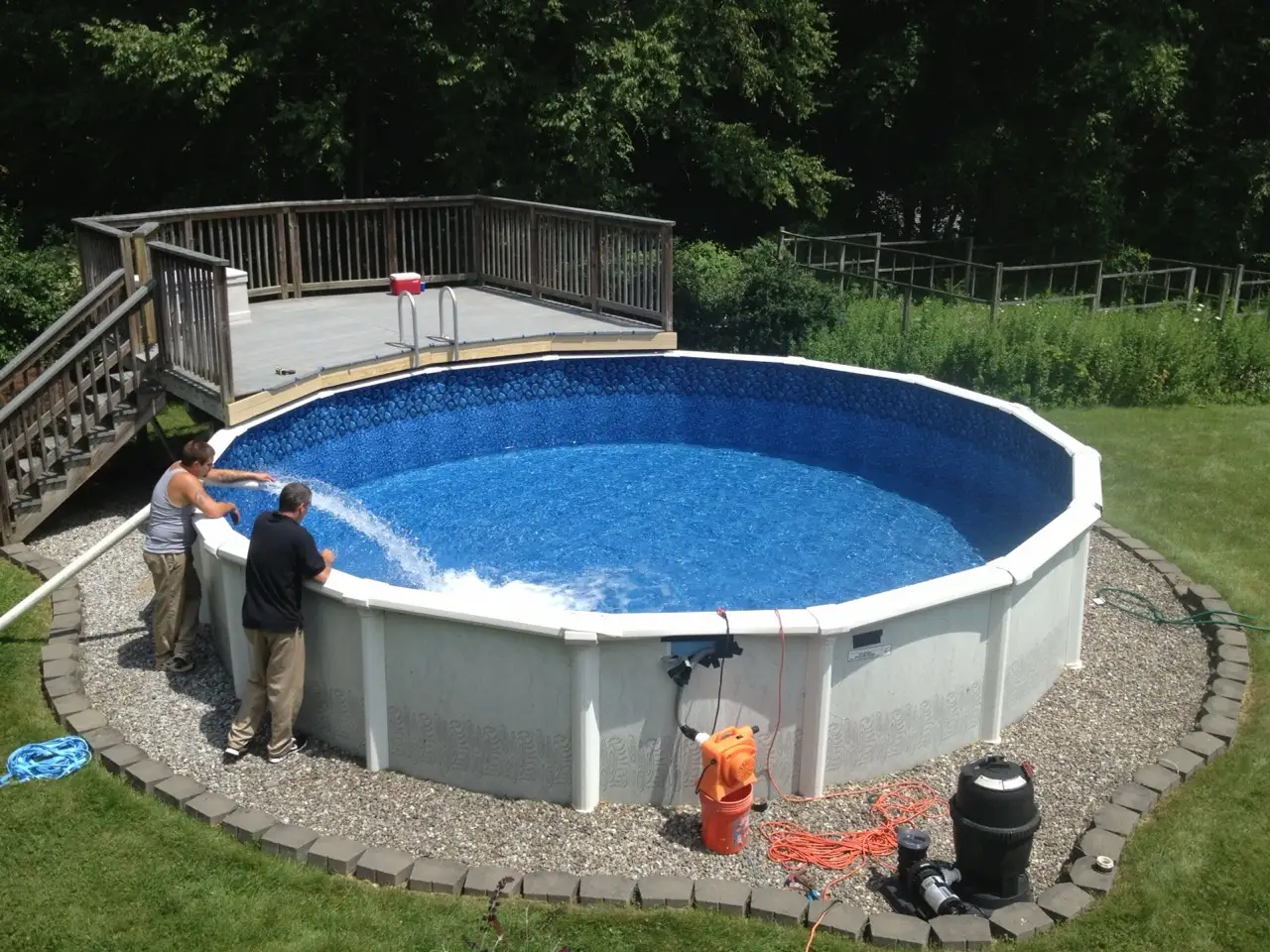
Why do above-ground pool permits get rejected?
A pool permit is mostly a location check and a safety check. The building department looks at the site plan to see where the pool sits, then at the barrier, the ladder and the power. The reasons an application can come back are below, each tied to a published rule.
1. The pool is too close to something
Every pool page lists minimum distances, and they are not the same as the ones for a shed or a fence.
| Measured from | Example rule | Source |
|---|---|---|
| Adjoining property lines | 6 feet | Westland, Michigan[1]; Wisconsin Rapids, Wisconsin[2] |
| The front property line | 25 feet | Westland[1] |
| The house | 10 feet | Wisconsin Rapids[2] |
| Any structure with a foundation | 15 feet | Gates, New York[3] |
| A septic tank or soil absorption field | 15 feet | Wisconsin Rapids[2] |
| A well, septic tank or leach bed | 20 feet | Gates[3] |
The pump counts as well. Wisconsin Rapids requires the filter, pump, heater and other equipment to be at least 15 feet from property boundary lines[2], so a pool that meets the 6-foot rule can still fail because the pump is tucked against the fence.
2. It is in the front yard or in an easement
Front yards are off limits in many places. Wisconsin Rapids allows pools only in a side or rear yard[2], Gates allows no pools in the front yard and counts a corner lot as having two front yards[3], and Westland requires 25 feet from the front line[1].
Easements are the hidden trap. Westland states that no pool may be located in an easement[1], and Gates says the same[3]. An easement does not show on the ground: it shows on the survey or the plat.
3. Overhead power lines
Overhead service drops cross many backyards. Westland requires overhead electrical wires to be at least 18 feet above and 10 feet horizontally from the pool or deck wall[1]. Wisconsin Rapids measures 10 feet from the vertical plane of the wire to the inside wall of the pool[2]. Gates asks for at least 10 feet from any overhead electrical service lines[3]. If the line is in the way, the pool moves, or the utility moves the line.
4. The barrier or the ladder does not work
The barrier is the main safety review. Under New York's code, quoted by East Syracuse, the barrier must be at least 48 inches above grade on the side away from the pool, with no more than 2 inches between the ground and its bottom; when the pool wall is the barrier, the ladder or steps must be capable of being secured, locked or removed, or be surrounded by a barrier of their own[4].
Common failures, against published rules:
- The wall is too low to count as the barrier, with no fence planned. DeWitt, Michigan, requires a fence, or a barrier mounted on the pool, for walls under 4 feet[5].
- A fixed ladder or step unit with no way to lock or remove it[4][5].
- Something to climb on next to the wall. Gates asks owners to remove anything within 5 feet that could be used to climb over the barrier or pool wall[3].
- No pool alarm in New York. Gates states that every pool must have a pool alarm that complies with ASTM F2208[3].
- A gate that does not close itself. Wisconsin Rapids requires self-closing, self-latching gates, with the release on the pool side when the latch is less than 54 inches above the bottom of the gate[2].
5. The power plan is missing or wrong
Wisconsin Rapids requires pool electrical work to follow Article 680 of NFPA 70[2]. Westland strictly forbids extension cords[1]. East Syracuse requires a third-party electrical inspection before the pool is used[4]. An application that shows the pump plugged into an outdoor outlet across the yard, or says nothing about power, invites a correction request.
6. The pool is too big for the yard
Wisconsin Rapids caps the ground area of a pool at 30 percent of the rear and side yards[2]. A large oval pool on a small lot can fail on that rule alone.
7. The file is incomplete
Missing documents stop the review before it starts. Westland requires a site sketch with lot lines, electrical lines and all structures, and a copy of the manufacturer's installation instructions[1]. Gates requires a survey map with the distances, the pool's specifications and either a contractor's insurance certificate or the homeowner's CE-200 form[3]. Wisconsin Rapids requires a detailed site plan showing setbacks and lot dimensions[2].
What happens if you skip the permit
Pools are visible, and the rules do not lapse because the pool is already full.
- Daily charges: Wharton, Texas, lists a fee of $100 per day for working without a permit[6].
- Fines for skipped inspections: Wisconsin Rapids warns that failing to call for required inspections can lead to delays, costs and a fine[2].
- Legalizing costs money: in New York City, legalizing unpermitted work on a one- or two-family home carries a $600 civil penalty, and removing the work instead carries the same penalty[7].
- It follows the house: Fairfax County, Virginia, applies its rules on unpermitted construction to properties that were bought and sold, regardless of when the work was done[8].
- Old pools are not grandfathered on safety: Wisconsin Rapids requires pools that existed before August 1, 2018, without compliant fencing to meet the fencing rules before water is put in[2].
How to avoid a refusal
Every item above is checkable before you apply: measure the distances on a real site plan, show the barrier and the ladder, say how the pump is powered and attach the manufacturer's information. That is what our All-in offer prepares for your address, with the rules of your own city, and follows until the permit is issued.
Common questions
Can I put an above-ground pool in my front yard?
Usually not. Wisconsin Rapids, Wisconsin, allows pools only in a side or rear yard, the Town of Gates, New York, allows no pools in the front yard, and Westland, Michigan, requires 25 feet from the front property line.
Can a pool go over a utility easement?
Not in Westland, Michigan, or Gates, New York, which both state that a pool cannot be placed in an easement. Check the easements on your survey before you choose the spot.
What if my pool was installed without a permit?
Talk to the building department. Expect to file the permit now and pass the inspections, and possibly to pay a penalty. In New York City, legalizing work done without a permit on a one- or two-family home carries a $600 civil penalty.
Can I reapply after a refusal?
Usually yes. Most refusals point to a fixable item, such as a distance on the site plan or a missing barrier detail. Move the pool, change the barrier or add the missing document, then resubmit.
We handle the permit. You build your above-ground pool.
- Your city's rule, for your addressThe code section, its link and the date we checked it.
- Site plan and dimensioned drawingsDistances to your property lines, ready for the application.
- The form, where to file it, and the published feePlus the documents list and an HOA request template.
- Reviewed, then revised until approvedWith All-in, after every comment from the city, for up to 6 months.
Sources
- City of Westland, Michigan, Residential Above Ground Swimming Pool Permit Application (revised July 1, 2026). Checked October 13, 2026.
- City of Wisconsin Rapids, Wisconsin, Pool permit (1 and 2 family residential). Checked October 13, 2026.
- Town of Gates, New York, Building Department, Above Ground Pool Permit Guidelines. Checked October 13, 2026.
- Village of East Syracuse, New York, Swimming Pools (permit rule and New York State building code extracts). Checked October 13, 2026.
- City of DeWitt, Michigan, Building and Fees, Swimming pools and fences. Checked October 13, 2026.
- City of Wharton, Texas, Residential Building Permit Fees. Checked October 13, 2026.
- New York City Department of Buildings, Form L2 instructions, civil penalties for work without a permit (rev. 03/2026). Checked October 13, 2026.
- Fairfax County, Virginia, Department of Code Compliance, Unpermitted Construction (September 2024). Checked October 13, 2026.