Why pole barn permits get rejected
Pole barn permits are refused or sent back for a few recurring reasons: the barn is too close to a property line, it exceeds the total size allowed for accessory buildings, the lot has no house yet, the design goes beyond the county's non-engineered limits, or the owner claims a farm exemption for a building that stores cars or will be lived in.
Updated
Rather not do this yourself? We prepare your pole barn permit file for your address, and revise it until approved.
Get my permit · $399Key facts
- Johnson County, Kansas, says any size structure is subject to setback requirements.[2]Johnson County, Kansas, Building Codes, Accessory and agriculture building permits
- Waterford Township limits sheds, pole barns, garages, carports and gazebos to a combined 1,444 square feet or 3% of the lot area, whichever is greater, up to 2,000 square feet.[1]Waterford Township, Michigan, Building permit requirements, residential accessory…
- Snohomish County, Washington, allows up to 24 by 36 feet, a 12-foot eave and posts 12 feet apart, and says the building can go smaller but not bigger than the design shown.[6]Snohomish County, Washington, Planning and Development Services, Assistance Bulletin…
- Laramie County warns that problems with the foundation, fire separation, plumbing and roof design appear when owners remodel a barn into a home, and that land-use rules may prohibit a second residence or a rental unit.[7]Laramie County, Wyoming, Planning and Development, Pole Barn Construction Guide and…
- Armada Township, Michigan, needs proof of ownership, two sets of scaled plans with wall and foundation details, and a plot plan showing the septic field, the well and existing and proposed utilities.[8]Armada Township, Michigan, Building application requirements for accessory buildings
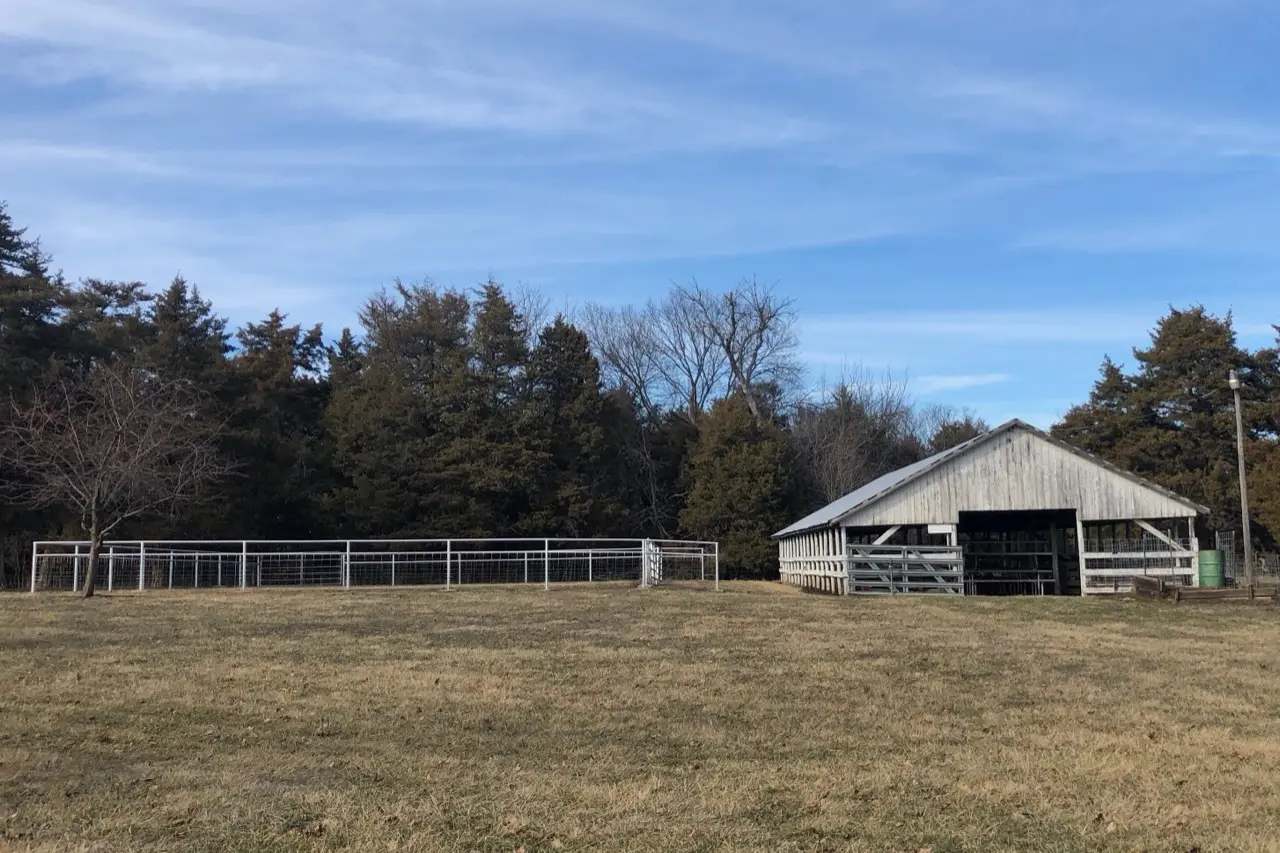
Why do pole barn permits get rejected?
A building department does not refuse a barn because it dislikes barns. It refuses, or sends back, an application that breaks a written rule or leaves a question unanswered. For pole barns, the same few problems come up again and again. Each one below comes with the official rule behind it.
1. The barn is too close to a property line
Setbacks apply to barns of every size. Johnson County, Kansas, says any size structure is subject to setback requirements[2]. Waterford Township, Michigan, is precise about it: a detached accessory building must be in the rear yard and at least 5 feet from the rear and side property lines, measured to the closest point of the building, overhangs included[1].
That last detail sinks plans. A barn drawn 5 feet from the line with a 2-foot roof overhang is only 3 feet away by that measurement. The fix is on the site plan: measure from the drip edge, not from the wall.
2. It is bigger than the zoning allows
Many places cap the total floor area of accessory buildings on a lot, not just each building. Waterford Township limits sheds, pole barns, garages, carports and gazebos to a combined 1,444 square feet or 3% of the lot area, whichever is greater, up to 2,000 square feet[1]. If you already have a detached garage, it counts against the same cap as the new barn.
3. There is no house on the lot
Waterford Township states that an accessory building cannot be located on a lot without a house[1]. If you bought land to put up a barn first and build the house later, check this rule before you order the kit.
4. The design goes beyond the county's limits
Counties that publish a non-engineered pole barn design set hard limits. Snohomish County, Washington, allows up to 24 by 36 feet, a 12-foot eave and posts 12 feet apart, and says the building can go smaller but not bigger than the design shown[6]. Laramie County, Wyoming, allows up to 40 by 60 feet and requires a Wyoming licensed engineer for anything that does not meet its guide[7]. In Johnson County, Kansas, a post-frame building must be designed by a Kansas-registered design professional[2].
An application with a 28-foot-wide barn on the Snohomish design, or a generic kit drawing in Johnson County, will come back for engineering.
5. The farm exemption does not fit the use
The agricultural exemption is the most misunderstood rule in pole barn permits.
- Prince William County, Virginia, may require a building permit when the principal use of the property is residential or the structure is not solely agricultural, even on land zoned A-1[5].
- Mason County, Michigan, does not allow residential storage in an exempt building, such as lawn tractors, cars, RVs or recreational equipment[3].
- Clark County, Washington, does not extend the exemption to residential accessory structures, shops or garages, and still requires plumbing and mechanical permits[4].
A permit file that describes a farm building, for a property with a house and no farm, invites questions.
6. The barn is meant to be lived in
A standard pole barn is designed as Risk Category I, a low-risk building that is normally unoccupied, while a home is Risk Category II, so Snohomish County requires additional engineering for a pole barn used as a residence[6]. Laramie County warns that problems with the foundation, fire separation, plumbing and roof design appear when owners remodel a barn into a home, and that land-use rules may prohibit a second residence or a rental unit[7].
7. The application is incomplete
Missing pieces stop the review before it starts. Armada Township, Michigan, needs proof of ownership, two sets of scaled plans with wall and foundation details, and a plot plan showing the septic field, the well and existing and proposed utilities[8]. Mason County, Michigan, wants a hand-drawn floor plan showing doors, windows and any workshop room, and an original signature, with faxes and PDFs not accepted[3]. Johnson County will not approve the permit without its accessory building use form[2].
What happens if you build without a permit
The penalties are published:
| Where | What it costs | Source |
|---|---|---|
| Armada Township, Michigan | Work started before the permit: $175 plus a $75 inspection fee; stop work order: $175 | [8] |
| Jerusalem, New York (2026) | Working without a permit: $250 or double the permit fee, whichever is greater; stop work order: $250 | [9] |
| Mason County, Michigan | A building not used exclusively for agriculture may need more permits, or be reconstructed, remodeled or removed | [3] |
| Fairfax County, Virginia | Notice of Violation; the owner must get the permits and inspections or remove the construction; the county may ask a court for fines or an order | [10] |
The exemption can also follow the sale. Clark County requires the seller of an exempt agricultural building to make the buyer aware of its exempt status[4], so a barn that has quietly become a shop or a garage becomes the buyer's question too.
How to avoid a refusal
Most refusals are visible before you file: a setback measured from the wrong point, a size cap already used up by the garage, a use that does not match the exemption, or a design one size too big for the county's standard plan. Our Permit Kit checks your county's written rules for your address and draws the site plan from them. The All-in offer adds the review before filing and handles each county comment until the permit is approved, with the "Approved or your money back" guarantee and its written conditions on the guarantee page.
Common questions
Can I build a pole barn on an empty lot?
Not everywhere. Waterford Township, Michigan, says an accessory building cannot be located on a lot without a house. Check your zoning before you buy land for a barn.
What happens if I build a pole barn without a permit?
You can be charged extra fees, ordered to stop, or required to bring the building into compliance. Armada Township, Michigan, charges $175 plus a $75 inspection fee when work starts before the permit and $175 for a stop work order. In Jerusalem, New York, working without a permit costs $250 or double the permit fee, whichever is greater.
Can the county check how I use an agricultural barn?
Yes, in some counties. Mason County, Michigan, says the building official may inspect and verify the use of an exempt agricultural building, and that a building not used exclusively for agriculture may need more permits or may have to be reconstructed, remodeled or removed.
Can I reapply after a refusal?
Usually you can correct the drawings or the site plan and resubmit. A refusal based on zoning, such as a size cap or a setback you cannot meet, needs a design change, or a variance where one is possible. A variance is a separate application with its own fee, for example $250 for an area variance in Jerusalem, New York, in 2026.
We handle the permit. You build your pole barn.
- Your city's rule, for your addressThe code section, its link and the date we checked it.
- Site plan and dimensioned drawingsDistances to your property lines, ready for the application.
- The form, where to file it, and the published feePlus the documents list and an HOA request template.
- Reviewed, then revised until approvedWith All-in, after every comment from the city, for up to 6 months.
Sources
- Waterford Township, Michigan, Building permit requirements, residential accessory buildings and structures (updated 07/22/2026). Checked October 13, 2026.
- Johnson County, Kansas, Building Codes, Accessory and agriculture building permits. Checked October 13, 2026.
- Mason County, Michigan, Building Department, Permits (agricultural building exemption). Checked October 13, 2026.
- Clark County, Washington, Agricultural structure permit exemption. Checked October 13, 2026.
- Prince William County, Virginia, Building Development Division, Pole barn. Checked October 13, 2026.
- Snohomish County, Washington, Planning and Development Services, Assistance Bulletin 113, Pole Buildings (revised September 2025). Checked October 13, 2026.
- Laramie County, Wyoming, Planning and Development, Pole Barn Construction Guide and Pole Barn/Accessory Building Restrictions. Checked October 13, 2026.
- Armada Township, Michigan, Building application requirements for accessory buildings (March 2025, fees and violations). Checked October 13, 2026.
- Town of Jerusalem, New York, Department of Code Enforcement and Zoning Administration Fee Schedule 2026. Checked October 13, 2026.
- Fairfax County, Virginia, Department of Code Compliance, April 2026 Code Compliance Corner. Checked October 13, 2026.