How to build a fire pit
Pick a spot at least 25 feet from any structure or combustible material, keep the fire area no wider than 3 feet, line the pit with non-combustible material such as brick, stone or steel, clear overhead branches and keep a hose or extinguisher at hand. Check your city first: some require a permit or an inspection before the first fire.
Updated
Rather not do this yourself? We prepare your fire pit permit file for your address, and revise it until approved.
Get my permit · $399Key facts
- A gas pit is an appliance with a burner, a pan and a gas line, and in many places the line alone needs a permit: Broomfield, Colorado, requires a building permit for every outdoor appliance fed from the building's gas meter.[5]City and County of Broomfield, Colorado, Outdoor Gas Fireplaces, Fire Pits and Natural…
- Portage, Michigan, issues recreational fire permits only after an inspection of the proposed site, and Williamsport, Pennsylvania, requires homemade fire pits to be inspected before their first use.[2][7]City of Portage, Michigan, Recreational Fire Permits
- Measure 25 feet from every structure and from anything combustible, and look up: Portage does not allow fire pits under low-hanging branches or other combustible materials, and Murray City lists "no overhead obstructions" among its rules.[2][3]City of Portage, Michigan, Recreational Fire Permits
- Yorba Linda asks for a listed and labeled burner assembly and a specification sheet stating the maximum BTUs and the testing agency.[6]City of Yorba Linda, California, Minimum Submittal Requirements for Residential Fire…
- Wheeling, wants a plat of survey with the pit's size and every distance marked, construction plans for a non-manufactured pit and a gas line diagram.[4]Village of Wheeling, Illinois, Fire Pit Requirements
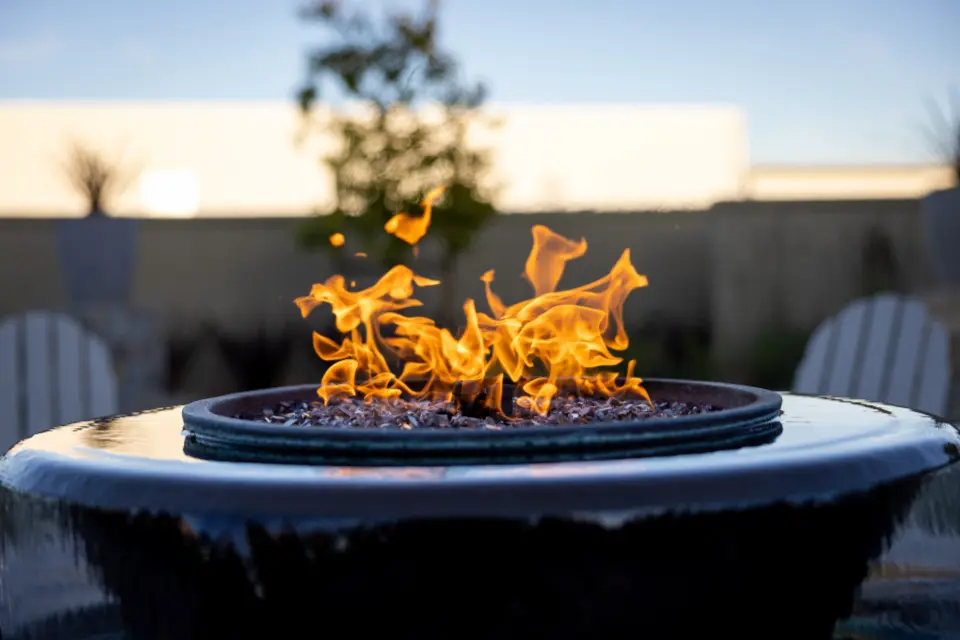
What should you decide before building a fire pit?
A fire pit is one of the simplest things you can build in a yard, and one of the easiest to put in the wrong place. Settle three things before you buy a single block.
Wood or gas. A wood pit is a hole, a ring and a fire. A gas pit is an appliance with a burner, a pan and a gas line, and in many places the line alone needs a permit: Broomfield, Colorado, requires a building permit for every outdoor appliance fed from the building's gas meter[5]. In some places the choice is made for you: Yorba Linda, California, states that wood burning fireplaces and pits are prohibited by the regional air district's Rule 445[6].
In-ground or above-ground. An in-ground pit is dug into the soil and edged with stone or block. An above-ground pit is a ring of block or a steel bowl sitting on a non-combustible base. Both are recreational fires under the fire code if the fuel area stays within 3 feet across and 2 feet high[1].
Built-in or portable. Wheeling, Illinois, treats them differently: portable manufactured fire pits must sit at least 15 feet from all structures, permanently constructed pits at least 25 feet from any structure or combustible material, and permanent pits also need a building permit[4].
The numbers that decide the design
The cities that publish fire pit rules keep coming back to the same handful of numbers, several of them taken from the International Fire Code (IFC):
| Rule | Typical value | Example |
|---|---|---|
| Distance to structures and combustibles | 25 feet | IFC 307.4.2, as quoted by Price City, Utah[1] |
| Maximum fuel area | 3 ft across, 2 ft high | IFC definition of a recreational fire[1] |
| Maximum pit diameter | 3 feet | Portage, Michigan[2]; Murray City, Utah[3] |
| Non-combustible surface around the pit | 18 inches | Murray City, Utah[3] |
| Depth of a belowground pit | at least 4 inches | Price City, Utah[1] |
| Distance to property lines | 25 ft "if possible" in Portage; 6 ft side and rear in Wheeling | Portage[2]; Wheeling[4] |
Draw these on a sketch of your yard before you decide where the pit goes. A 25-foot circle around the pit has to stay clear of the house, the garage, the shed and any wood fence. On many suburban lots, that circle fits in only one or two places, or nowhere.
How to build a wood-burning fire pit, step by step
Check your city's rules and permits
Call or search your city's fire department and building department pages. Portage, Michigan, for example, issues recreational fire permits only after an inspection of the proposed site[2], and Williamsport, Pennsylvania, requires homemade fire pits to be inspected before their first use[7]. Knowing this now saves you from building something an inspector will ask you to move.
Choose and mark the spot
Measure 25 feet from every structure and from anything combustible, and look up: Portage does not allow fire pits under low-hanging branches or other combustible materials[2], and Murray City lists "no overhead obstructions" among its rules[3]. Pick level ground away from the property line; in Portage, a pit closer than 25 feet to a property line needs the neighbor's written approval[2]. Mark a circle no more than 3 feet across for the fire area with spray paint or a string and stake.
Dig the pit
Remove the sod inside the circle and dig the bowl. For an in-ground pit, Price City requires at least four inches of depth[1]. Keep the inside floor as bare earth: Portage requires fire pits to be lined with non-combustible material such as brick or rock, with bare earth inside the liner[2].
Build the ring
Set the first course of non-combustible blocks, stones or a steel ring around the hole, level it, and stack the courses you want. Price City asks for belowground pits to be surrounded above ground by a non-combustible material such as steel, brick or masonry[1]. Keep the opening at 3 feet or less across, so the fire stays a recreational fire[1]. If your design includes seat walls, check your city first: Yorba Linda requires a permit and inspections for framed or masonry walls 3 feet or more in height[6].
Lay the non-combustible apron
Surround the ring with gravel, pavers or stone. Murray City requires an 18-inch non-combustible surface around the pit[3]. The apron also keeps chairs, grass and stray embers off the edge.
Put the safety gear in place
Before the first fire, run a garden hose to the pit or set an extinguisher next to it. The fire code requires a portable fire extinguisher rated at least 4-A, or other on-site equipment such as dirt, sand, a water barrel or a garden hose, available for immediate use[1]. Portage requires a garden hose connected to a water supply any time a fire is lit[2].
Light it the legal way
Burn clean firewood only. Price City prohibits using recreational fires to dispose of garbage, weeds, leaves or other yard waste[1]. Portage requires an adult 18 or older to attend the fire until it is out, bans fires when the wind is 10 mph or more, and requires every fire to be out before midnight[2]. Your city's hours and wind limits may differ.
How to build a gas fire pit
A gas fire pit is built like a ring, but the inside is an appliance. Three things change.
Listed parts. Broomfield requires the gas fireplace or fire pit to be listed for exterior use, with specification sheets for every burner and for the pan or shield, both listed for their use[5]. Yorba Linda asks for a listed and labeled burner assembly and a specification sheet stating the maximum BTUs and the testing agency[6].
The gas line. Broomfield requires below-grade gas piping to be buried at least 12 inches deep and protected against corrosion, and outdoor above-ground piping to be raised at least 3½ inches above the ground[5]. In Yorba Linda, under the California Mechanical Code, plastic gas pipe must be buried with at least 18 inches of cover and a #14 gauge tracer wire[6]. The two numbers differ because the codes differ, which is why your own city's rule matters.
The tests. In Broomfield, new gas piping is pressure tested at 10 psi for at least 10 minutes under IRC Section G2417, and the pipe inspection must happen before anything is buried[5]. A final inspection then checks the installation and the appliance[5].
If you are not a licensed gas fitter, this is the part to hand over. Broomfield notes that separate permits are required when different contractors install the gas piping and the appliance[5].
Common mistakes
- Building first, measuring later. The 25-foot distance is the rule people discover after the patio is poured.
- A pit wider than 3 feet. It looks generous, but it is no longer a recreational fire under the IFC definition[1] and breaks the size cap in cities like Portage and Murray[2][3].
- Seat walls with no permit. In Yorba Linda, a masonry wall 3 feet tall needs a permit and footing inspections even if the fire pit itself does not[6].
- Burying the gas line before the inspection. Broomfield requires the inspection before any piping is buried or concealed[5].
- Ignoring the neighbors. In Portage, a pit within 25 feet of a property line needs written approval from the neighboring owner[2], and in Williamsport a fire that becomes a public nuisance is put out[7].
Before you dig: the permit
The steps above are the easy part. The hard part is knowing which of your city's three possible approvals apply to your pit, building, burning and gas, and what each one wants on paper. Wheeling, for example, wants a plat of survey with the pit's size and every distance marked, construction plans for a non-manufactured pit and a gas line diagram[4].
That paperwork is what we prepare. The All-in, until approved offer ($399) includes the rules for your address with links, a site plan with the distances your city checks, drawings for the pit and any walls, the forms and fees, a review before you file and our follow-up on city comments until the permit is issued. Read the fire pit permit guide for what cities ask for, and the reasons fire pit permits get refused.
Common questions
How deep should an in-ground fire pit be?
Price City, Utah, requires belowground fire pits to be at least four inches deep and surrounded above ground by a non-combustible material such as steel, brick or masonry. Your city may set its own rule, so check before you dig.
How big can a backyard fire pit be?
The International Fire Code defines a recreational fire as a fuel area of 3 feet or less in diameter and 2 feet or less in height. Cities such as Portage, Michigan, and Murray City, Utah, cap fire pits at 3 feet in diameter.
Can I build a fire pit on my wood deck?
A wood-burning recreational fire must be kept 25 feet from structures and combustible material under the International Fire Code as quoted by Price City, Utah, and Wheeling, Illinois, counts decks among the structures a portable fire pit must stay away from. A wood deck is the combustible material the rule is written for.
Do I need a permit to build a fire pit?
It depends on the city and on the fuel. Wheeling, Illinois, requires a building permit for any fire pit; Murray City, Utah, requires no permit for single family homes; Prince William County, Virginia, requires a permit only for gas or propane pits.
We handle the permit. You build your fire pit.
- Your city's rule, for your addressThe code section, its link and the date we checked it.
- Site plan and dimensioned drawingsDistances to your property lines, ready for the application.
- The form, where to file it, and the published feePlus the documents list and an HOA request template.
- Reviewed, then revised until approvedWith All-in, after every comment from the city, for up to 6 months.
Sources
- Price City, Utah, Recreational Fires in Price City Limits (quotes the 2021 International Fire Code, definitions, 307.4.2 and 307.5). Checked October 13, 2026.
- City of Portage, Michigan, Recreational Fire Permits. Checked October 13, 2026.
- Murray City, Utah, Fire Department, Recreational Fire Pit Guidelines. Checked October 13, 2026.
- Village of Wheeling, Illinois, Fire Pit Requirements. Checked October 13, 2026.
- City and County of Broomfield, Colorado, Outdoor Gas Fireplaces, Fire Pits and Natural Gas Grills (May 2024). Checked October 13, 2026.
- City of Yorba Linda, California, Minimum Submittal Requirements for Residential Fire Pits, Outdoor Fireplaces and Built-In Barbeques. Checked October 13, 2026.
- City of Williamsport, Pennsylvania, Bureau of Fire, Recreational Fires and Open Burning. Checked October 13, 2026.