How to build a fence
To build a wood fence, confirm the property line and the height your zoning code allows, call 811, then lay out the line with string and mark the posts. Set the posts in concrete footings deep enough for the fence height and your wind, let them cure, attach the rails, then the boards, finished side facing out where the city requires it.
Updated
Rather not do this yourself? We prepare your fence permit file for your address, and revise it until approved.
Get my permit · $399Key facts
- San Diego's prescriptive fence design calls for boards and rails of Western Cedar No. 2, Redwood No. 2 or better, and posts of Redwood No. 2 or pressure-treated Western Cedar No. 1 or better.[1]City of San Diego, California, Development Services, Information Bulletin 222,…
- Parkland, Florida, requires lumber of No. 2 grade or better and corrosion-resistant fasteners for wood fences.[2]City of Parkland, Florida, Wood fence requirements per the Florida Building Code and…
- Duluth requires fence builders to call Gopher One Call before they dig, and Waverly asks applicants to call Iowa One Call before contacting the city.[3][4]City of Duluth, Minnesota, Fence Permits
- Cleveland Heights requires the structural parts of a residential fence to face the owner's property, so the neighbor sees the finished side.[5]City of Cleveland Heights, Ohio, Fence permitting information
- Oakdale, Minnesota, charges $47.50 for a fence up to 6 feet and $58 over 6 feet in 2025, and Waverly charges nothing.[7][4]City of Oakdale, Minnesota, Ordinance 942, 2025 Fee Schedule
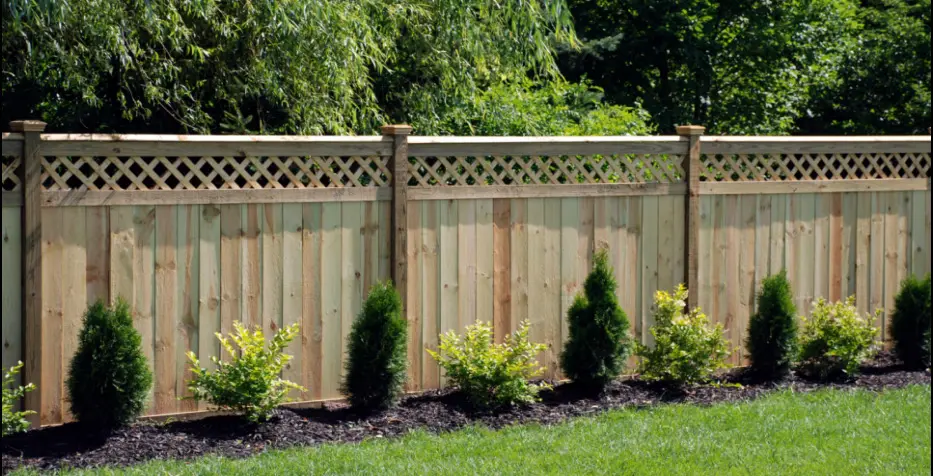
Plan the fence before you buy posts
A fence is a straight line of posts in the ground, and nearly every expensive mistake happens before the first post: the line is on the neighbor's land, the fence is too tall for the yard, or a post lands on a buried cable. Settle four things first.
- Where the property line is. Waverly, Iowa, makes locating the property pins the owner's responsibility[4]. If you cannot find the pins, a survey settles it before the posts go in.
- How tall the fence may be, yard by yard. Zoning sets it. Cleveland Heights, Ohio, allows 4 feet in the primary front yard and 6 feet in side and rear yards[5]; Duluth, Minnesota, allows 4 feet in front (6 feet if ornamental and at least 50% open) and 8 feet in side and rear yards[3]. Corner lots and fences next to houses have their own limits, explained on the fence permit page.
- What is under the ground and on the plat. Duluth bars fences from drainage easements and floodways[3]; Waverly bars any structure from a utility or drainage easement[4].
- Whether you need a permit. The building code exempts fences up to 7 feet from the building permit[6], but many cities require a fence permit anyway: Duluth for any fence 4 feet or taller[3], Waverly before construction begins[4].
Materials that last
Pick materials the local design is written for. San Diego's prescriptive fence design calls for boards and rails of Western Cedar No. 2, Redwood No. 2 or better, and posts of Redwood No. 2 or pressure-treated Western Cedar No. 1 or better[1]. Parkland, Florida, requires lumber of No. 2 grade or better and corrosion-resistant fasteners for wood fences[2]. Concrete for post footings in San Diego must reach 2,500 psi at 28 days[1].
Step by step
Call 811 and mark the line
Have buried utilities marked before any digging. Duluth requires fence builders to call Gopher One Call before they dig[3], and Waverly asks applicants to call Iowa One Call before contacting the city[4]. Then drive a stake at each end and corner and pull a tight string between them, a little inside the property line if your city does not allow fences right on it. Duluth, for example, allows fences along or within the property line but at least 3 feet from a street or alley right of way[3].
Space the posts
Mark the posts along the string. Gate and corner posts first, then line posts between them. Use the spacing your local design allows: under Parkland's Florida Building Code requirements, posts of a 6-foot wood fence are 4x4s spaced no more than 4 feet on center, 5 feet for a 5-foot fence and 6 feet for a 4-foot fence[2].
Dig the post holes to the right depth
Depth grows with the fence height. San Diego's prescriptive footing depths[1]:
| Fence height | Post footing depth (San Diego) |
|---|---|
| 3 ft | 2 ft 3 in |
| 4 ft | 2 ft 6 in |
| 5 ft | 3 ft |
| 6 ft | 3 ft 3 in |
| 7 ft | 3 ft 6 in |
Parkland's rule for fences up to 6 feet is simpler: posts embedded 2 feet into a concrete footing 10 inches in diameter and 2 feet deep[2]. Holes must be in undisturbed natural ground or properly compacted fill in San Diego's design[1].
Set the posts in concrete
In San Diego's design, posts sit in 12-inch diameter concrete footings placed over 3 inches of loose gravel, and wood posts extend through the concrete onto the gravel below[1]. Set the corner and end posts first, plumb them on two faces, brace them, then pull a string along their tops to set the line posts at the same height. Let the concrete cure before you hang anything on the posts.
Attach the rails
Fasten horizontal rails between the posts. Parkland requires 2x4 members fastened with two 16d galvanized nails at each attachment[2]. Check each rail for level as you go; a fence that steps down a slope needs each section level on its own.
Hang the boards or panels
Attach the boards to the rails. In Parkland, boards less than 8 inches wide get two 8d galvanized nails at each connection[2]. Decide which side faces out before you start: Cleveland Heights requires the structural parts of a residential fence to face the owner's property[5], so the neighbor sees the finished side.
Build and hang the gate
Gates take the most load. Hang them on the strongest posts, with a latch that lines up when the post settles. If the fence encloses a pool, the gate rules are stricter: Parkland requires pool barrier gates to be self-closing, self-latching and to open outward away from the pool[2].
Mistakes that cost a fence
- Measuring from the sidewalk. Duluth warns that the street right of way often extends into the front yard beyond the sidewalk or curb, and requires fences to stay 3 feet from it[3].
- The wrong height in the wrong yard. A 6-foot panel is legal in a Waverly back yard and 3 feet too tall in its front yard[4]. On a corner lot, Duluth treats both street sides as front yards[3].
- Posts too shallow for the height. San Diego's footing depth grows from 2 feet 3 inches for a 3-foot fence to 3 feet 6 inches for a 7-foot fence[1].
- The good side facing in. Cleveland Heights requires the posts and rails to face the owner's side[5].
- A tall fence on a simple permit. Above 7 feet, the building code exemption ends[6], and Duluth requires a building permit in addition to the fence permit[3].
Before you dig: do you need a permit?
Most fence trouble is not the carpentry, it is the paperwork that should have come first: a fence over the yard's height limit, across an easement, or past the line. Fixing that can mean taking the fence down. The permit itself is usually modest: Oakdale, Minnesota, charges $47.50 for a fence up to 6 feet and $58 over 6 feet in 2025[7], and Waverly charges nothing[4].
What the city wants to see is a site plan with the fence line, the height in each yard, the property line, easements and right of way[3] [4]. That is the part we prepare: our permit team builds the file for your address with the zoning rule and its link. The All-in offer adds our review before you file and every round of city comments until the permit is issued.
Common questions
How deep should fence posts be?
It depends on the fence height and the local wind and soil. San Diego's prescriptive design sets post footing depths from 2 feet 3 inches for a 3-foot fence to 3 feet 3 inches for a 6-foot fence. Parkland, Florida, embeds posts of a 6-foot fence 2 feet into a 2-foot-deep concrete footing 10 inches in diameter.
How far apart should fence posts be?
Follow your local design. In Parkland, Florida, under the hurricane-zone rules of the Florida Building Code, posts of a 6-foot wood fence are spaced no more than 4 feet apart, 5 feet for a 5-foot fence and 6 feet for a 4-foot fence.
Which side of the fence faces the neighbor?
Some cities decide it for you. Cleveland Heights, Ohio, requires the structural parts of a residential fence, the posts and rails, to face the property of the fence owner.
Do I need to call 811 before digging fence post holes?
Yes. Duluth, Minnesota, requires fence builders to call Gopher One Call before digging, and Waverly, Iowa, asks applicants to have underground utilities marked through Iowa One Call before contacting the city.
We handle the permit. You build your fence.
- Your city's rule, for your addressThe code section, its link and the date we checked it.
- Site plan and dimensioned drawingsDistances to your property lines, ready for the application.
- The form, where to file it, and the published feePlus the documents list and an HOA request template.
- Reviewed, then revised until approvedWith All-in, after every comment from the city, for up to 6 months.
Sources
- City of San Diego, California, Development Services, Information Bulletin 222, Prescriptive designs for fences. Checked October 13, 2026.
- City of Parkland, Florida, Wood fence requirements per the Florida Building Code and pool barrier sections. Checked October 13, 2026.
- City of Duluth, Minnesota, Fence Permits. Checked October 13, 2026.
- City of Waverly, Iowa, Fence Permit, residential fence regulations. Checked October 13, 2026.
- City of Cleveland Heights, Ohio, Fence permitting information (updated August 2025). Checked October 13, 2026.
- City of Benson, Arizona, Work not requiring a permit, according to the 2024 International Residential Code (Section R105.2). Checked October 13, 2026.
- City of Oakdale, Minnesota, Ordinance 942, 2025 Fee Schedule. Checked October 13, 2026.